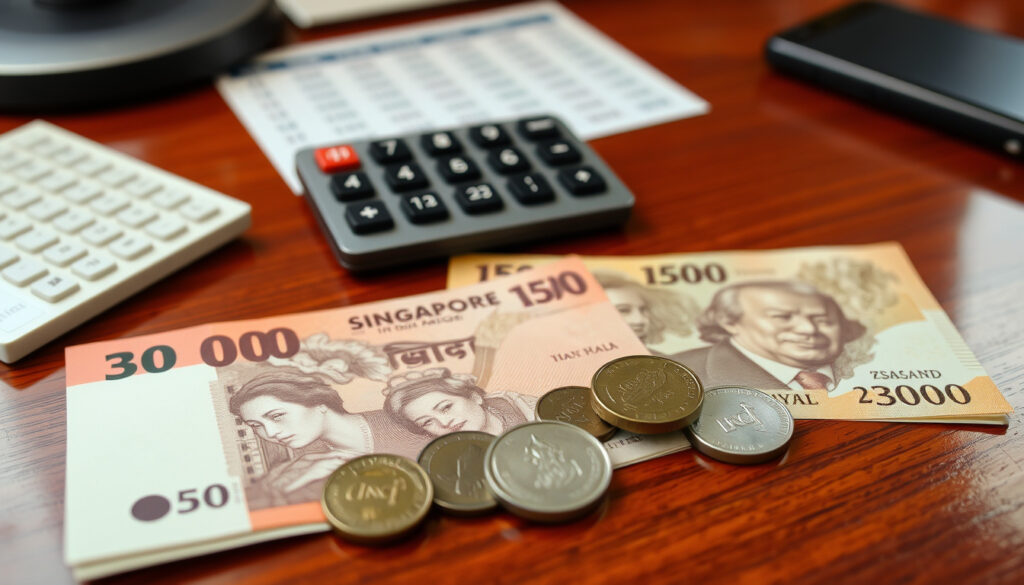
Singapore Dollar (SGD) to THB: Exchange Rate & Conversion Guide
Anyone who has ever priced a trip to Singapore knows the currency question: how far will the Singapore dollar stretch in baht? It’s a fair thing to wonder, because the SGD is a heavy hitter in Southeast Asia and the rate moves almost daily.
Current exchange rate (approx): 1 SGD ≈ 26.00 THB ·
Currency code: SGD ·
Symbol: S$ ·
Denominations: 6 banknotes, 6 coins
Quick snapshot
- The Singapore dollar is Singapore’s official currency and is divided into 100 cents (Investopedia).
- Common banknote denominations are S$2, S$5, S$10, S$50 and S$100 (Travelex).
- Larger notes like the S$1,000 exist but are kept out of daily use (OFX).
- The exact SGD/THB rate moves daily and differs between the central bank’s mid-rate and retail counter rates (Bank of Thailand, Bangkok Bank).
- Which rate applies to you depends on whether you’re buying baht with cash, a traveller’s cheque, or a transfer (Bangkok Bank).
- Whether the S$1,000 note is accepted in everyday shops varies; it functions more as a large-denomination store of value (Travelex).
- In early September 2026, OFX’s retail quote ranged from about 25.41 to 26.05 THB per SGD on the same page (OFX).
- Thailand’s Export-Import Bank published its own SGD table on 2026-09-03, a useful cross-check for official rates (Export-Import Bank of Thailand).
- The Thai Customs Department’s search page showed export/import rates around 25.47 and 26.12 THB on 2026-09-02 (Thai Customs Department).
- If the rate stays near 26.00, 1,000 THB converts to roughly 38.5 SGD (Investing.com converter).
- For large cash exchanges, comparing a bank’s bank-note buying rate with its transfer rate can change the final amount by hundreds of baht. (Investing.com converter)
- Watch the Bank of Thailand’s daily release if you need the official mid-rate for accounting or tax calculations (Bank of Thailand).
Six specifications tell you almost everything about the SGD, and the pattern is simple: the currency is tied to a 1:100 cent structure, with banknotes handling everyday large payments and coins covering small change.
| Specification | Detail |
|---|---|
| Official currency | Singapore dollar (Investopedia) |
| ISO code | SGD (Export-Import Bank of Thailand) |
| Subunit | Cent, with 1 SGD = 100 cents (Investopedia) |
| Current reference rate (approx) | 1 SGD ≈ 26.00 THB; spot near 25.99 (Investing.com) |
| Banknote denominations | S$2, S$5, S$10, S$50, S$100, S$1,000 (Currency.Wiki) |
| Rate publication | Daily rates listed by Thai authorities (Export-Import Bank of Thailand) |
How much is 100 Singapore dollars in Thai baht?
At the approximate mid-market rate of 26.00 THB per SGD, 100 Singapore dollars is about 2,600 baht. At the spot quote of 25.9871 from Investing.com, the same 100 SGD is closer to 2,599 baht (Investing.com).
For a traveler, the difference between 2,591 and 2,600 baht is pocket change; for a large transfer, it adds up to hundreds of baht.
How much is 50 SGD in THB?
- 50 SGD × 26.00 = 1,300 THB (approx).
- Using the spot rate above, 50 SGD ≈ 1,299.36 THB.
How much is 2 SGD in THB?
- 2 SGD × 26.00 = 52 THB (approx).
- Using the spot quote, 2 SGD ≈ 51.97 THB.
The implication: the commonly quoted “26 baht” shortcut is useful for mental math, but always check the day’s actual mid-rate for payments, refunds, or invoicing.
How much is 1 Singapore cent in Thai baht?
Because 1 SGD = 100 cents, one cent is 0.01 SGD. At 26.00 THB per SGD, that works out to about 0.26 baht — or 26 satang in Thailand’s own subunit.
How much are 10 cents?
- 10 Singapore cents = 0.10 SGD = about 2.60 THB at 26.00.
- At the official mid-rate of 25.9143, 10 cents = 2.59 THB (Bank of Thailand).
How much are 50 cents?
- 50 Singapore cents = 0.50 SGD = about 13.00 THB at 26.00.
- At the official mid-rate, 50 cents = 12.96 THB (Bank of Thailand).
What this means: cent denominations don’t affect big transfers, but they matter in Singapore’s cash economy, where a coffee might cost S$2.20 and the 20-cent coin is part of daily change.
What are the denominations of the Singapore dollar?
Singapore uses a clean two-part system: polymer banknotes for larger amounts and coins for small change. The notes in common circulation are S$2, S$5, S$10, S$50 and S$100, with the S$1,000 note available for institutional use (Travelex).
The S$1,000 note is legal in Singapore but rarely accepted at hawker stalls or small shops, so treat it as a banknote for banks, not breakfast.
What banknotes are available?
- Full banknote set: S$2, S$5, S$10, S$50, S$100, S$1,000 (OFX).
- The S$1,000 note is issued but not part of daily cash flow.
What coins are in circulation?
- Common circulating coins: 5c, 10c, 20c, 50c, S$1 (Currency.Wiki).
- The 100-cent system also includes a 1-cent coin in official listings, though daily change stays at 5c and above.
The pattern: Singapore’s cash system is designed for small everyday purchases — small notes for coffee, mid-size notes for shopping, and the S$1,000 note for institutional or emergency cash reserves.
What is the Singapore dollar rate today?
There is no single “today” rate, because the central bank publishes a mid-rate, banks post buy/sell columns, and money changers add their own spread. On the Bank of Thailand’s display, the SGD mid-rate stood at 25.9143 THB (Bank of Thailand). OFX showed a retail quote near 25.41 THB on 2026-09-01 and a chart value of 26.05 THB (OFX). Thai Customs, meanwhile, listed export and import rates of 25.4730 and 26.1238 THB on 2026-09-02 (Thai Customs Department). Investing.com’s spot page showed 25.9871 with a previous close of 26.1155 (Investing.com), and Bank Negara Malaysia’s rates put 1 SGD around 3.19 ringgit as an independent regional cross-check (Bank Negara Malaysia).
How does the rate compare to yesterday?
- The previous close of 26.1155 versus the current spot of 25.9871 is a normal daily move for SGD/THB.
- A one-day shift of 0.1–0.3 baht is common, so comparing “today” with “yesterday” only matters for large transfers.
What is the rate at SuperRich?
- SuperRich and other Thai money changers publish their own buy/sell rates; those differ from the mid-rate because they include a margin.
- For a cash exchange, the bank-note buying rate is the one that decides how much baht you receive (Bangkok Bank).
Why this matters: if you’re moving 100,000 THB, a 0.30 baht difference on the SGD side can shift your final amount by more than 1,100 baht — enough to justify a quick rate comparison before you exchange.
How many Singapore dollars can I get for 1000 Thai baht?
At 26.00 THB per SGD, 1,000 THB buys about 38.5 Singapore dollars. Currency.Wiki’s snapshot showed 1 SGD = 25.852633 THB, which puts 1,000 THB at roughly 38.68 SGD (Currency.Wiki).
What is the reverse conversion rate?
- Reverse rate = 1 ÷ 26.00 ≈ 0.0385 SGD per THB.
- At the Customs Department’s export rate of 25.4730, 1,000 THB ≈ 39.26 SGD.
The trade-off: online converter values are indicative, not guaranteed; the rate you actually get depends on the channel — cash, TT, or card — and the exact moment of execution.
Singapore dollar (SGD) at a glance
Eight lines cover the essentials; the reason to read them is simple: knowing which denominations exist and how they’re quoted helps you avoid surprises when paying in cash or converting in Thailand.
| Specification | Detail |
|---|---|
| Currency name | Singapore dollar (Investopedia) |
| ISO code | SGD |
| Symbol | S$ |
| Subunit | 100 cents per dollar (Investopedia) |
| Common banknotes | S$2, S$5, S$10, S$50, S$100 |
| Large-denomination note | S$1,000, not commonly circulated |
| Common coins | 5c, 10c, 20c, 50c, S$1 |
| Official coin denominations | 1c, 5c, 10c, 20c, 50c, S$1 (Currency.Wiki) |
| Typical rate range | ~25.41–26.12 THB per SGD, early Sep 2026 |
| Bank rate columns | Bank-note buying, selling, sight bill, TT |
| Cash conversion example | 100 SGD ≈ 2,591–2,600 THB |
| Reverse conversion example | 1,000 THB ≈ 38.5–38.8 SGD |
The practical read: official specs stay constant, but the rate columns are the moving part — which is why checking the right column matters more than memorizing any single number.
How to exchange Singapore dollars for Thai baht in Thailand
Follow these steps to get a fair rate whether you’re a tourist or a remittance sender.
- Check the mid-rate. Start with the Bank of Thailand’s SGD page for the official mid-rate (Bank of Thailand).
- Compare cash and transfer rates. Bangkok Bank publishes separate bank-note and TT rates; the bank-note buying rate is usually lower (Bangkok Bank).
- Use a converter for a ballpark figure. Investing.com’s SGD/THB converter gives a quick estimate (Investing.com converter).
- Check the bank’s rate at the counter. The displayed rate is what you’ll get for cash; confirm before handing over SGD.
- For large amounts, get a quote. TT or online transfer rates can beat cash counter rates by 0.5–1%.
If you’re converting on the Thai side, the deciding factor is the bank’s buying rate for SGD banknotes. On the Singapore side, compare transfer providers before sending money to a Thai bank account — the spread matters more than the headline mid-rate.
What’s confirmed vs what’s still unclear
Confirmed facts
- SGD is Singapore’s official currency, with 100 cents per dollar (Investopedia).
- Common banknotes: S$2–S$100; S$1,000 exists but is rare (Travelex).
- Coins in daily use: 5c, 10c, 20c, 50c, S$1 (Travelex).
- Thai authorities publish SGD rates daily (Thai Customs Department, Bank of Thailand).
What’s unclear
- Live retail rates differ from the mid-rate and each other (OFX, Bangkok Bank).
- Whether you get the published rate depends on the counter’s note condition and your negotiation.
- The S$1,000 note’s acceptance varies by merchant (Travelex).
- The exact rate changes constantly and varies between sources.
What the balance says: for SGD/THB, the confirmed core is stable — denominations and structure — while the live rate is always a variable to look up.
What the sources say
At the Bank of Thailand’s official display, the SGD mid-rate was published at 25.9143 THB — a solid baseline for anyone converting Singapore dollars into baht.
Singapore’s cash system is built around polymer banknotes in S$2, S$5, S$10, S$50 and S$100 denominations, while coins handle the change in 5, 10, 20 and 50 cent and S$1 steps.
Banks list multiple SGD/THB rates side by side — bank-note buying, bank-note selling, sight bill and TT selling — and the number you receive depends on which one you use.
The thread across these sources: SGD/THB has a stable structural backbone, but the rate you get is a product decision, not a fixed fact.
Summary
For a Thai traveler heading to Singapore, the exchange rate isn’t a headline number — it’s a daily decision that changes how much hawker dinner or MRT ride each SGD buys. The smart move is to convert via a bank or money changer that shows its rate openly, check the mid-rate once in the morning, and treat anything within 0.3 baht of it as normal. For an investor or business owner moving tens of thousands of baht, the decision is starker: use a TT rate or a transfer service, not cash counter rates, or the spread alone can erase a week of gains.
Frequently asked questions
Is the Singapore dollar stronger than the Thai baht?
Yes. One SGD buys roughly 26 THB, which means the Singapore dollar is considerably stronger than the baht (Bank of Thailand).
Can I use Singapore dollars in Thailand?
No. Thailand uses baht; SGD is not accepted at ordinary shops. You need to exchange SGD for THB at banks or licensed money changers (Bangkok Bank).
What is the best day to exchange currency?
There’s no reliable “best” day. Rates move in small daily steps, and the main factor is comparing the bank’s buying and selling columns before you exchange (Bangkok Bank).
Do I need to carry cash or use card in Singapore?
Cards are widely accepted, but cash matters for hawker centres and small shops. Carry small notes — S$2 and S$10 — plus coins for everyday purchases (Travelex).
How to identify counterfeit Singapore dollars?
Check the polymer substrate and see-through windows; the notes are made from polymer to resist counterfeiting. Money changers and banks in Thailand will also run quick authentication checks (Travelex).
Are there limits on exchanging currency in Thailand?
Cash exchange counters set their own limits; banks typically ask for ID for larger cash conversions. The safest route is to compare the bank’s listed rates and follow their counter rules (Bangkok Bank).
If you still need a specific figure, the fastest path is to ask the counter for their buy rate — that’s the number that matters.
Related reading
More related posts
 Paradox Rift Card List: Full Set, Best Cards & Prices
 Best Portable Power Stations 2026: Home, Car & Ireland Picks
 Nissan GT-R 2024: Price, Specs, Performance, and More
 How to Hang Shelves: Beginner Guide, No Drill, Brackets
 Brian Wong Shi Xiang Sentenced: Megan Khung Case
 Payment Crackdown: Trustly Withdraws as Nordic Regulators Tighten Net
 The Line Restaurant Reviews: Is Shangri-La’s Buffet Worth It