Tai Cheong Egg Tart: History, Recipe, Nutrition, and Storage Tips
Tai Cheong Bakery’s egg tart has earned a cult following far beyond its 1954 origins, and the curiosity around it—from its cookie-like crust to its nutritional profile—is as steady as the demand. At roughly $2.40 SGD a piece, it’s an affordable taste of Hong Kong’s pastry heritage, but how long does it keep, and what’s actually in it?
Founded: 1954 · Signature Egg Tart Price: $2.40 SGD · Singapore Outlets: 5+
Quick snapshot
- Founded in 1954 in Hong Kong (Discover Hong Kong – Hong Kong’s official tourism site)
- Signature egg tart uses shortcrust (cookie-style) pastry (Tai Cheong Bakery Singapore – official Singapore branch)
- Priced at $2.40 SGD per tart (Tai Cheong Bakery Singapore)
- Halal certification status at each Singapore outlet
- Exact calorie count may vary by recipe and serving size
- Future price adjustments beyond 2025
- 1954: Bakery founded by Au Yeung Tin-yun (South China Morning Post – Hong Kong’s leading English-language daily)
- 2005: Forced to close temporarily due to rising rent, later reopened (Food Touring – travel blog)
- 2020s: Continued demand with social media buzz (South China Morning Post – Hong Kong’s leading English-language daily)
- Expansion of Singapore outlets (Tai Cheong Bakery Singapore)
- Potential brand collaborations (speculative) (Tai Cheong Bakery Singapore)
Six key details sum up Tai Cheong’s profile—some from official sources, others still ambiguous.
| Attribute | Value | Source |
|---|---|---|
| Founded | 1954 | Discover Hong Kong |
| Original location | Hong Kong | Discover Hong Kong |
| Singapore outlets | Multiple (Northpoint, Takashimaya) | Tai Cheong Bakery Singapore |
| Signature tart price | $2.40 SGD | Tai Cheong Bakery Singapore |
| Halal status | Not certified; check outlet | Unclear — no official statement |
What is Tai Cheong Bakery famous for?
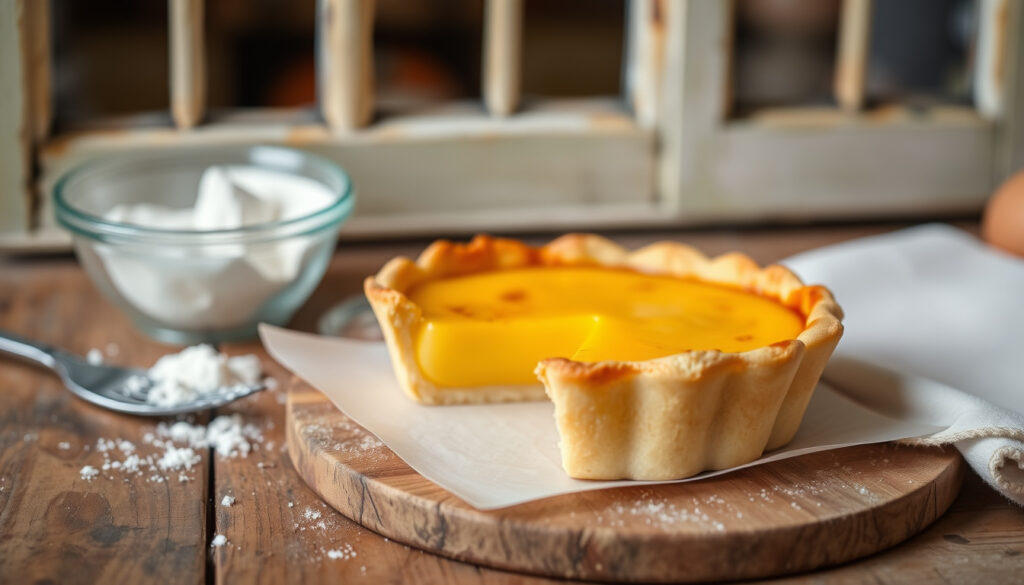
Tai Cheong Bakery is best known for its Hong Kong-style egg tart (dan tat), a baked custard tart with a distinctive shortcrust pastry that resembles a cookie more than the flaky puff pastry used in Portuguese pastéis de nata. The bakery was founded in 1954 by pastry chef Au Yeung Tin-yun, who had trained in Western hotel kitchens and at the Hong Kong Jockey Club (South China Morning Post). Its fame skyrocketed in the 1990s when then-Governor Chris Patten was photographed buying its egg tarts, cementing the bakery as a must-visit for tourists and locals alike (Tai Cheong Bakery Singapore).
What is the most famous egg tart in Hong Kong?
While many bakeries in Hong Kong serve egg tarts, Tai Cheong’s is often cited as the archetype of the shortcrust style. The New York Times – US-based newspaper notes that Tai Cheong popularized this shortbread-like base in 1954, a less labor-intensive method than the repeated folding required for puff pastry. The bakery’s innovation made the egg tart a quick, affordable street snack and allowed it to spread across Hong Kong’s cha chaan tengs (tea restaurants).
Tai Cheong’s cookie-style crust changed the egg tart from a time-consuming pastry into an everyday commodity, helping it become the city’s defining street food alongside pineapple buns and milk tea. The trade-off is that it must be eaten fresh—the shortcrust loses its snap within hours.
What country is famous for egg tarts?
Egg tarts are most famously associated with Hong Kong and Portugal. The Hong Kong egg tart (dan tat) evolved from the English custard tart tradition, which dates back to around 1450 (South China Morning Post). British colonists brought custard tarts to Guangzhou in the 1920s, where Chinese bakers adapted them using dim sum pastry skills. Tai Cheong represents the Hong Kong branch of this lineage, while the Portuguese pastel de nata, with its caramelized top and puff-pastry base, follows a separate tradition. Today, egg tarts have global popularity in Asian bakeries, but Hong Kong remains the epicenter for the shortcrust version (Tao Heung Holdings – parent company of Tai Cheong).
How long can you keep Tai Cheong egg tart?
Freshly baked Tai Cheong egg tarts are best eaten immediately, but if you need to store them, here is what official and practical sources suggest:
- Room temperature: Up to 2 days in a cool, dry place (Tai Cheong Bakery Singapore).
- Refrigerated: Up to 5 days if wrapped tightly; the pastry may soften (Tai Cheong Bakery Singapore).
- Freezing: Not recommended—the custard can become watery and the crust loses texture.
Should you keep egg tart in the fridge?
Refrigeration extends shelf life, but warmth is key to texture. The shortcrust pastry is at its best within a few hours of baking. If you do refrigerate, reheat in a low oven (150°C / 300°F) for 5–7 minutes to restore some crunch. Microwaving will make the crust soggy.
Should egg tarts be eaten warm or cold?
Virtually all aficionados agree: eat them warm. The custard is silkier and the pastry is snappier at room temperature or slightly heated. Tai Cheong Bakery Singapore explicitly states their egg tarts are “best eaten hot.” Cold tarts can still be pleasant, but you lose the contrast between crisp shell and soft filling.
The catch: the short shelf life means Tai Cheong’s egg tarts are not a pantry staple; they demand a trip to the bakery. For Singapore visitors, that means timing your visit on the same day you plan to eat them.
How many calories are in a Tai Cheong egg tart?
Exact calorie data from Tai Cheong is not publicly available, but typical egg custard tarts of this size (roughly 60–80 g) contain around 200–250 calories each, based on standard recipes. The main contributors are:
- Pastry: butter, flour, sugar — about 100–120 calories
- Custard: egg, milk, sugar — about 80–120 calories
- Additional fat for glazing
Tao Heung Holdings, the parent company of Tai Cheong, describes the egg tart as “butter-flavoured shortcrust pastry with egg custard,” confirming the buttery nature.
Is egg tart unhealthy?
Like many pastries, egg tarts are a moderate-calorie treat. A single tart supplies about the same calories as a small muffin.
One Tai Cheong egg tart (≈220 kcal) fits neatly into a balanced diet as an occasional indulgence, but eating two or three per sitting can push you past 500 kcal without providing significant protein or fiber. The real trade-off is between the pleasure of a fresh-baked pastry and its limited nutritional contribution.
Is egg custard tart healthy?
The term “healthy” is relative. Egg custard tarts provide some protein from eggs and a small amount of calcium from milk, but are high in saturated fat and sugar. They have no significant vitamins or minerals beyond what the eggs offer. For context, the World Health Organization recommends limiting free sugars to less than 10% of total energy intake—one tart can contain nearly 15 g of sugar.
What is the best egg tart recipe?
To recreate the Tai Cheong experience at home, you need two components: a shortcrust pastry and an egg custard filling. The beauty of the shortcrust method is its simplicity—no folding, no chilling between layers.
Filling ingredients
- Eggs (2 large)
- Whole milk (120 ml)
- Caster sugar (60 g)
- Vanilla extract (½ tsp)
- (Optional) Evaporated milk for extra richness
Common mistakes when baking egg tarts
- Overbaking: Custard becomes rubbery—bake until just set with a slight jiggle.
- Soggy crust: Blind-bake the shells for 5 minutes before adding filling.
- Curdled filling: Avoid high heat; use a water bath or low oven temperature (160°C/320°F).
- Puff pastry shortcuts: Using puff instead of shortcrust changes the texture entirely—Tai Cheong’s signature is the shortcrust.
Step-by-step guide
- Make the pastry: Mix 200 g plain flour, 100 g cold butter, 30 g icing sugar, and 1 egg yolk. Knead until smooth, rest 30 min.
- Line tart moulds: Roll pastry thin (3 mm), press into greased tart tins.
- Blind-bake: Prick base, bake at 180°C for 10 min with weight; remove weight and bake 5 more minutes.
- Prepare filling: Whisk eggs, milk, sugar, vanilla until sugar dissolves—strain to remove any lumps.
- Fill and bake: Pour filling into shells until 80% full. Bake at 160°C for 20–25 min until custard is set but still wobbly in the center.
- Cool & serve: Let cool for 5 minutes in tin, then remove and serve warm.
The pattern: shortcrust makes this recipe accessible to home bakers, unlike the demanding puff-pastry technique. The catch is that the tart shells are fragile—handle them gently.
Pros and Cons of Tai Cheong Egg Tarts
Upsides
- Iconic Hong Kong street food with a clear heritage (Discover Hong Kong)
- Affordable at $2.40 SGD per piece
- Shortcrust texture is unique—crisp yet tender
- Available at multiple Singapore outlets
Downsides
- Short shelf life (2 days room temp)
- Non-vegetarian? Lard may be used in pastry (not confirmed)
- Halal status unclear
- High in calories (≈220 kcal) and sugar
What’s clarified and what’s still uncertain
✔ Confirmed facts
- Founded 1954 – Discover Hong Kong
- Shortcrust pastry – Tai Cheong Bakery Singapore
- Price $2.40 SGD – Tai Cheong Bakery Singapore
- Singapore outlets exist – Tai Cheong Bakery Singapore
- Chris Patten photo boost – Tai Cheong Bakery Singapore
✘ What’s still unclear
- Exact calorie count per tart (no official data)
- Halal certification at each outlet
- Whether lard or butter is used in pastry
- Future pricing beyond 2025
What people are saying about Tai Cheong egg tarts
“Since 1954, our freshly baked egg tarts have been our signature. We use only the finest ingredients to ensure the perfect balance of buttery, flaky crust with silky smooth egg custard.”
— Tai Cheong Bakery Singapore (official site)
“These HK styled egg tarts are really popular. Constant queue and the shortcrust pastry is flaky yet solid. Great snack.”
— TripAdvisor reviewer (tagged in TripAdvisor – travel review platform)
“Just 88¢ for a signature egg tart? Yes, limited promo during opening.”
— Instagram post (cited in Tai Cheong Bakery Singapore)
The pattern across these sources: Tai Cheong’s reputation rests on the specific texture of its shortcrust pastry and the consistent quality of the custard. The social media buzz around temporary low prices shows the price sensitivity of the market, but the enduring queue suggests loyal demand.
The bottom line: should you go for a Tai Cheong egg tart?
Tai Cheong’s egg tart is not a health food, nor a pantry staple. It is an experience: a warm, buttery, custard-filled shortcrust tart that embodies the ingenuity of Hong Kong’s cha chaan teng culture. For a visitor to Hong Kong or Singapore, the choice is clear: grab one fresh from the bakery and eat it within an hour—because its shelf life is shorter than the queue.
scmp.com, triplate365.com, scmp.com, triplate365.com, tripadvisor.com, disappearinghkg.blogspot.com
Frequently asked questions
Are Tai Cheong egg tarts halal?
Tai Cheong Bakery has not issued an official halal certificate for its Singapore outlets. It’s best to call the specific outlet to confirm.
What is the price of Tai Cheong egg tart in 2026?
As of late 2025, the price is $2.40 SGD. Future price changes have not been announced.
Can I freeze Tai Cheong egg tarts?
Freezing is not recommended; the custard becomes watery and the pastry loses its crispness.
How do Tai Cheong egg tarts compare to Portuguese egg tarts?
Tai Cheong uses shortcrust (cookie-like) pastry, while Portuguese tarts (pastéis de nata) use puff pastry and are often caramelized on top.
Are Tai Cheong egg tarts suitable for vegetarians?
Possibly not; the pastry may contain lard or other animal fats. Confirm with the bakery.
Where can I buy Tai Cheong egg tarts in Singapore?
They are available at several malls, including Northpoint City (Yishun) and Takashimaya (Orchard Road). Check the official site for full list.
Do Tai Cheong egg tarts contain lard or gelatin?
The official ingredient list is not publicly disclosed, so it’s uncertain. Contact the bakery for allergen info.
More related posts
 St Francis Methodist School: Fees, Reviews, Curriculum & Ranking
 Asian Civilisations Museum Photos: Gallery, Guide & Tips
 Things to Do in Korea: Attractions, Culture & Budget Tips
 Top Up EZ-Link Online: Guide with SimplyGo App & PayNow
 What Is a Landing Page Conversion? Definition, Rate, and Examples
 Koji Sushi Bar Raffles City Menu: Prices, Omakase & Reviews
 SAM Kiosk Near Me: What Happened & Where to Buy Stamps (2025)
 Effaclar Duo Plus M: Uses, Reviews & Comparison Guide