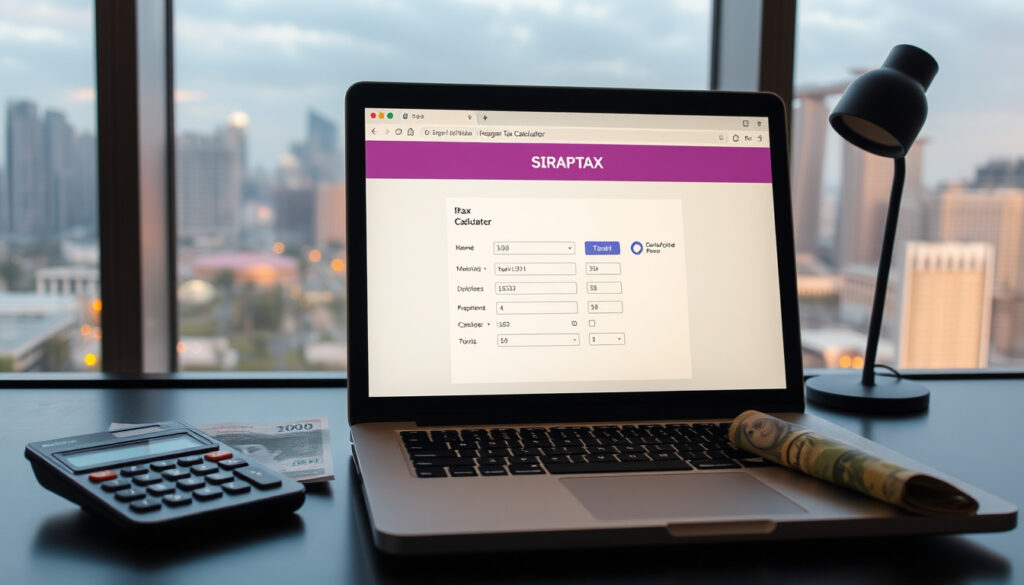
IRAS Income Tax Calculator 2026: How to Use & Calculate Tax in Singapore
If you’re living or working in Singapore, tax season brings one big question: how much do I actually owe? The IRAS income tax calculator takes the guesswork out of that estimate by turning your income and reliefs into a clear number. In this guide, we’ll walk through using the official tool for Year of Assessment 2026, with real examples and the tax brackets you need to know.
Maximum marginal tax rate for residents (YA 2026): 24% · Tax-free threshold for residents: First SGD 20,000 · Number of resident tax brackets (YA 2026): 12 · Non-resident tax rate (flat): 24% (or 15% at option for certain income)
Quick snapshot
- Resident tax rates for YA 2026 are published by IRAS (Singapore’s tax authority)
- The IRAS income tax calculator is available for download as an XLSM file (IRAS (Singapore’s tax authority))
- Personal reliefs reduce chargeable income before tax is applied (IRAS (Singapore’s tax authority))
- Exact tax treatment of certain foreign-sourced income depends on remittance timing
- Impact of future legislative changes beyond YA 2026
- Filing window for Tax Season 2026: 1 Mar 2026 to 18 Apr 2026 (IRAS)
- Employers in the Auto-Inclusion Scheme submit income info by 1 Mar each year (IRAS)
- Verify pre-filled data and file your return by 18 Apr 2026
- Receive Notice of Assessment and pay tax within 1 month
| Attribute | Value |
|---|---|
| Tax authority | Inland Revenue Authority of Singapore (IRAS) |
| Year of Assessment | 2026 (income earned in 2025) |
| Resident tax rate range | 0% to 24% |
| Non-resident tax rate | 24% flat (or 15% for certain income) |
| Tax-free threshold (resident) | First SGD 20,000 chargeable income |
| Calculator format | Microsoft Excel with macros (.xlsm) |
What is the Income Tax bracket in Singapore 2026?
Resident tax rates for Year of Assessment 2026
Singapore uses a progressive tax system for residents. For YA 2026, the rates range from 0% on the first SGD 20,000 to 24% on income above SGD 1,000,000. There are 12 brackets in total, according to IRAS (Singapore’s tax authority). The table below shows the key brackets:
| Chargeable income (SGD) | Rate |
|---|---|
| 0 – 20,000 | 0% |
| 20,001 – 30,000 | 2% |
| 30,001 – 40,000 | 3.5% |
| 40,001 – 80,000 | 7% |
| 80,001 – 120,000 | 11.5% |
| 120,001 – 160,000 | 15% |
| 160,001 – 200,000 | 18% |
| 200,001 – 240,000 | 19% |
| 240,001 – 280,000 | 19.5% |
| 280,001 – 500,000 | 22% |
| 500,001 – 1,000,000 | 23% |
| Above 1,000,000 | 24% |
The pattern: the first SGD 20,000 is completely tax-free, then the rate climbs quickly in the early brackets to 7% by SGD 40,000. For a typical salaried employee earning SGD 60,000, only SGD 40,000 is chargeable after the first SGD 20,000 exemption — the effective rate stays low.
Non-resident tax rates and withholding tax
Non-residents are taxed at a flat rate of 24% on all Singapore-sourced income, as confirmed by IRAS (Singapore’s tax authority). However, for certain rental income or income subject to withholding tax, the rate may be 15% at the option of the non-resident. Unlike residents, non-residents do not benefit from the SGD 20,000 tax-free threshold. The implication: a non-resident earning SGD 60,000 would owe 24% on the full amount — SGD 14,400 — compared to a resident paying roughly SGD 2,650 on the same gross income after reliefs.
Residents get progressive rates and reliefs; non-residents face a flat 24% with no deductions. If you qualify as a resident in 2025, your tax bill will be far lower — especially at modest income levels.
How should I calculate my Income Tax?
Using the official IRAS income tax calculator (XLSM file)
IRAS provides a free downloadable Microsoft Excel workbook with macros (.xlsm) that automatically computes your tax. The tool is updated each year with the latest brackets and reliefs. IRAS (Singapore’s tax authority) notes that the calculator requires you to enable macros — a security step that allows the formulas to run.
Manual calculation with tax bracket table
You can also compute tax by hand using the brackets above. The formula: subtract the tax-free portion, then apply each marginal rate to the remaining slices of income. For example, a chargeable income of SGD 50,000: first SGD 20,000 at 0%, next SGD 10,000 at 2% (SGD 200), next SGD 10,000 at 3.5% (SGD 350), final SGD 10,000 at 7% (SGD 700) — total SGD 1,250.
Step-by-step example for a resident earning SGD 60,000
- Gross annual income: SGD 60,000
- Employee CPF contribution (20%): SGD 12,000
- Chargeable income after CPF: SGD 48,000
- Tax-free threshold: SGD 20,000 (0%)
- Tax on next SGD 10,000 at 2%: SGD 200
- Tax on next SGD 10,000 at 3.5%: SGD 350
- Tax on next SGD 8,000 at 7%: SGD 560
- Total tax before reliefs: SGD 1,110
Actual liability can be lower because personal reliefs like earned income relief or course fees reduce chargeable income further. The IRAS basic guide (official guidance) explains that taxpayers can adjust reliefs during e-filing.
For a typical salaried employee, the IRAS calculator saves 15 minutes of manual bracket math — and reduces errors around the progressive edge where each bracket applies.
What is the maximum I can earn without paying income tax?
Tax exemption threshold for residents
Residents pay no tax on the first SGD 20,000 of chargeable income. But the effective tax-free amount can be much higher once personal reliefs are applied. According to IRAS (Singapore’s tax authority), the general filing threshold is total income above SGD 22,000 — meaning someone earning exactly SGD 22,000 likely owes no tax.
Impact of personal reliefs on the effective tax-free amount
- Earned income relief: SGD 1,000 (age below 55) to SGD 8,000 (age 60+), automatically granted
- CPF relief: full employee contribution (up to SGD 20,600 for 2025)
- Course fees, life insurance, and other deductions
Example: earning SGD 25,000 with no other income
- Gross: SGD 25,000
- Employee CPF (20%): SGD 5,000 → chargeable income: SGD 20,000
- First SGD 20,000 at 0% → tax = SGD 0
The catch: non-residents get no tax-free threshold, so even SGD 1 of Singapore-sourced income attracts the 24% flat rate.
How much tax will I pay if I earn 40k?
Tax calculation for gross annual income of SGD 40,000
- Gross: SGD 40,000
- Employee CPF (20%): SGD 8,000
- Chargeable income: SGD 32,000
- Tax-free first SGD 20,000: SGD 0
- Next SGD 10,000 at 2%: SGD 200
- Next SGD 2,000 at 3.5%: SGD 70
- Total tax: SGD 270
That is the base. After personal reliefs (e.g., earned income relief of SGD 1,000), chargeable income drops to SGD 31,000, reducing tax to about SGD 235. The IRAS basic guide (official guidance) reminds taxpayers to claim all eligible reliefs via the online filing form.
What income is not taxed in Singapore?
List of tax-exempt income for individuals
- Capital gains – not taxed, as confirmed by IRAS (Singapore’s tax authority)
- Foreign-sourced income remitted to Singapore – may be exempt under the territorial tax system, subject to conditions
- Individual dividends from Singapore companies – tax-exempt under the one-tier corporate tax system
- Interest from approved Singapore banks – tax-exempt for individuals
What this means: Singapore taxes only income earned in or derived from Singapore, with no capital gains tax — a major advantage for investors.
| Feature | Detail |
|---|---|
| File format | XLSM (macro-enabled Excel) |
| Compatibility | Microsoft Excel 2010 or later (macOS version with macros enabled) |
| Input fields | Employment income, business income, rental income, dividends, CPF contributions, personal reliefs |
| Output | Total income, chargeable income, tax before reliefs, tax after reliefs, net tax payable |
| Update cycle | Annually (new file each Year of Assessment) |
| Language | English |
Step-by-Step Guide to Using the IRAS Income Tax Calculator
- Download the calculator from the IRAS e‑filing page (official site). Look for the “Tax Calculator” download under the Individual Income Tax section.
- Enable macros when you open the file. In Excel, click “Enable Content” if prompted. The calculator will not work without macros enabled.
- Fill in your personal details: Name, NRIC/FIN (optional), Year of Assessment (2026), and residency status.
- Enter your income: Use the tabs provided – Employment Income, Trade Income, Other Income. IRAS pre‑fills employment income for employers under the Auto‑Inclusion Scheme, but you must verify all entries against your payslip or Form IR8A.
- Enter CPF contributions: The calculator may pre‑fill this if you use the auto‑inclusion version; otherwise enter your total employee CPF for the year.
- Claim your personal reliefs: In the relevant section, add earned income relief (automatic for residents), course fees, life insurance, CPF top‑ups, and other deductions. The calculator reduces chargeable income immediately.
- Review the summary sheet: The calculator shows total income, total reliefs, chargeable income, tax before reliefs, and final tax payable. Adjust any figures until everything matches your actual records.
- Save or print the result. Use this estimate to plan your tax payment or to check against the Notice of Assessment you will receive after filing.
The IRAS calculator runs offline once downloaded – no internet connection required after the file is saved.
Confirmed facts and what remains uncertain
Confirmed facts
- Resident tax rates for YA 2026 range from 0% to 24%, published by IRAS (Singapore’s tax authority)
- The official IRAS income tax calculator (XLSM) is available for free download
- Personal reliefs reduce chargeable income before tax is computed
- Filing window: 1 Mar 2026 to 18 Apr 2026
- Tax must be paid within 1 month of the tax bill
What remains unclear
- How specific foreign‑sourced income will be treated depends on the timing and method of remittance
- Any future legislative changes after YA 2026 that could affect rates or reliefs
“Taxpayers should verify that all pre‑filled information is accurate and complete. They may adjust details such as additional sources of income and changes to personal relief claims by filing their Income Tax Return by 18 Apr 2026.”
IRAS – Tax Season 2026 guide (official)
“If you are a Direct Notice of Assessment (D‑NOA) taxpayer, you will receive a tax bill finalized from your employer‑submitted income, prior approved reliefs, and other records if no action is required. If the information is inaccurate, use the Amend Tax Bill digital service within 30 days.”
IRAS – Basic guide for new individual taxpayers (official)
Making the calculator work for you
The IRAS income tax calculator is a straightforward, free tool that turns income data into a reliable estimate in minutes. Its real value lies in testing scenarios: what if you contribute more to CPF? What if you take a course? For a resident earning SGD 60,000, the difference between claiming all reliefs and none can be hundreds of dollars. For the taxpayer in Singapore, the choice is clear: spend 10 minutes with the calculator before you file, or risk paying more than you owe.
Frequently asked questions
Is the IRAS income tax calculator free?
Yes. The calculator is provided free of charge by IRAS as an Excel file downloaded from their official website.
Do I need to enable macros to use the calculator?
Yes. The file uses macros to compute tax automatically. Enable macros when prompted, or the formulas will not run.
Can non-residents use the calculator?
Yes. The calculator includes a section for non-residents and applies the flat 24% rate (or 15% option) accordingly.
What is the difference between gross income and chargeable income?
Gross income is your total earnings before any deductions. Chargeable income is gross income minus allowable reliefs and deductions. Only chargeable income is taxed.
How often are the tax rates updated?
IRAS updates the tax rate schedule annually. The YA 2026 rates apply to income earned in calendar year 2025.
What happens if I enter the wrong relief amounts?
An incorrect relief entry could understate or overstate your tax. You can correct it during e-filing or use the Amend Tax Bill digital service within 30 days of receiving your tax bill.
Is the calculator officially endorsed by IRAS?
Yes. It is published on the IRAS website as the official personal income tax calculator for residents and non-residents.
Related reading
More related posts
 Cafe in the West: Best Cafes Newcastle West & Castleblayney
 Our Tampines Family Clinic: Hours, CHAS & Services
 Express Teppan-Yaki Tampines Mall: Halal Menu & Reviews
 Song Ha-Yoon: Actress Bio, Career, Bullying Controversy
 Xiaomi Service Centre Singapore: Repairs & Options
 100 Singapore Dollars to Malaysian Ringgit – SGD to MYR Today
 DBS Credit Card Hotline: Numbers, Hours, and Waiver Requests
 Botafogo de Futebol e Regatas: Debts, Rivals, Titles