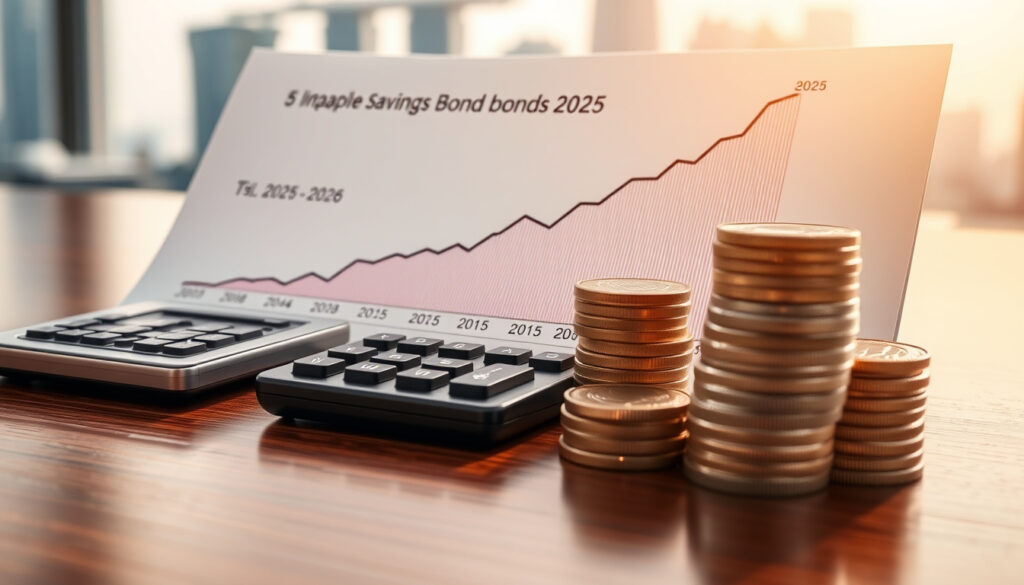
SSB Interest Rate Projection 2026: Current Rates & Forecast
Singapore Savings Bonds are caught between two forces: a steady 2.11% 10-year average that looks modest next to promotional savings accounts, yet offers unmatched flexibility and government backing. This guide projects SSB rates through mid-2027 using MAS data, compares them to fixed deposits and high-interest accounts, and helps you decide where your next dollar should go.
Current 10-year average return (SSB June 2026): 2.11% per annum · First-year interest rate (latest SSB issue): 1.46% per annum · Maximum annual subscription limit per individual: S$200,000 · Historical 10-year average range (since 2015): 1.5% – 3.5% per annum · Interest rate for 10-year Singapore government bond (SGS) as of June 2026: ~2.5% per annum
Quick snapshot
- SSB June 2026 issue: 10-year average return 2.11% p.a. (Monetary Authority of Singapore (MAS))
- First-year coupon for June 2026 issue: 1.46% p.a. (MAS)
- Maximum holding per person: S$200,000 (StashAway (investment platform))
- Application deadline for June 2026 issue: 25 June 2026 (MAS)
- Exact future SSB rates beyond June 2026 depend on SGS yield movements, which are influenced by global economic conditions and US Federal Reserve policy.
- Whether SGD strengthening against USD in 2026 will push domestic bond yields lower is uncertain.
- Potential changes to SSB policy (e.g., cap adjustments) are not announced in advance.
- SSB 10-year average fell from 2.14% (Feb 2026) to 2.08% (projected Aug 2026) according to Beansprout (SSB projection tool) — labelled low accuracy.
- Dr Wealth reports a gradual downtrend into March 2026 (1.99%), then a rise to 2.14% in April, holding at 2.11% for May–June 2026 (Dr Wealth (personal finance site)).
- Next SSB issue announcement: first business day of July 2026. (Beansprout projection of 2.12%)
- If SGS 10-year yields stay near 2.5%, the next SSB 10-year average could hover around 2.08–2.12% (based on Beansprout projection of 2.12%).
| Fact | Value |
|---|---|
| Current SSB 10-year average return (June 2026) | 2.11% per annum |
| Current 1-year fixed deposit rate (average) | 2.4% per annum |
| Savings account highest promo rate (OCBC 360) | 3.5% per annum (conditional) |
| SSB maximum holding per individual | S$200,000 |
| SSB early redemption penalty | No penalty after 1st year; redemption within 1st year forfeits full interest |
| Next SSB issue announcement date | First business day of July 2026 |
These six numbers frame the entire SSB decision: a middle-of-the-pack return that trades headline rate for unconditional access.
What Is the Prediction for Singapore Savings Bonds?
Projecting SSB rates means understanding how MAS sets them. Each SSB’s interest is linked to the Monetary Authority of Singapore (MAS) formula based on Singapore Government Securities (SGS) yields. As of June 2026, the 10-year SGS bond yield sits around 2.5%.
Current SSB interest rate (June 2026 issue)
- The June 2026 Singapore Savings Bond (SBJUN26) offers a 10-year average return of 2.11% per annum, with a first-year interest rate of 1.46% (MAS).
- StashAway notes that this issue carries a stepped coupon structure, with interest payments rising from 1.46% in year 1 to 2.81% in year 10 (StashAway (investment platform)).
- The June 2026 issue’s application window closes on 25 June 2026 (MAS).
Projecting future SSB rates using SGS bond yields
- Beansprout’s projection tool, which uses MAS’s published formula, estimated on 23 May 2026 that the next SSB could offer a 2.12% 10-year average return (Beansprout (SSB research site)).
- A later update from Beansprout’s tool projected a 2.08% average return for the August 2026 issuance, though the tool labels this projection with low accuracy (Beansprout projection tool).
- Dr Wealth notes that SSB returns fell below 1% in 2020, then surged in 2022 as global rates rose; the 10-year SGS has mostly yielded between 2% and 3% over the past decade (Dr Wealth (personal finance site)).
Bottom line: Near-term SSB projections (July–August 2026) point to a 10-year average return around 2.08–2.12%, assuming SGS yields stay near current levels. For savers with a 5–10 year horizon, locking in now at 2.11% is a reasonable bet against future rate cuts; for shorter horizons, the risk of rates drifting lower is real.
The implication: SSB rates are likely to remain in the low 2% range through late 2026 unless SGS yields shift materially — which would require action from the Fed or a sharp change in Singapore’s economic outlook.
Savers chasing a guaranteed return above 2.5% today face a choice: accept the liquidity and safety of SSBs at 2.11%, or jump into conditional high-interest savings accounts that demand salary crediting and card spend — and risk rate cuts next quarter.
What Is the Interest Rate on Savings Bonds in Singapore 2026?
MAS announces SSB interest rates monthly. Each issue has a fixed stepped coupon schedule over 10 years, with lower initial payments that increase over time. The table below shows how rates have evolved in the first half of 2026.
| SSB Issue | First-year interest | 10-year average return | Source |
|---|---|---|---|
| January 2026 (SBJAN26) | 1.38% | 2.05% | MAS |
| February 2026 (SBFEB26) | 1.42% | 2.08% | MAS |
| April 2026 (SBAPR26) | 1.46% | 2.11% | MAS |
| June 2026 (SBJUN26) | 1.46% | 2.11% | MAS |
Five months, one pattern: after a dip in March (1.99% per Dr Wealth), the 10-year average has stabilised around 2.11%.
The pattern: the upward creep from January’s 2.05% to April’s 2.11% reflects a modest rise in SGS yields, but the range remains narrow — suggesting that SSB rates have found a floor near 2.0% and a ceiling around 2.2% in the current rate environment.
Is It Worth Investing in Singapore Savings Bonds?
To answer that, we need to weigh SSBs against the other safe-harbour options available to Singapore retail savers right now.
Upsides
- Backed by the Singapore government — essentially zero credit risk.
- Penalty-free early redemption after the first year; you can withdraw any amount without losing accrued interest.
- Stepped coupons mean your effective yield increases the longer you hold.
- Maximum holding of S$200,000 allows meaningful allocations.
Downsides
- Current 10-year average of 2.11% is lower than the best promotional savings accounts (e.g., OCBC 360 up to 3.5% p.a., but with conditions).
- If you redeem within the first year, you forfeit all interest — effectively a 0% return for the first 12 months.
- S$2 transaction fee per application (StashAway).
- Rates are fixed for the life of the bond — if market rates rise, you’re locked into a lower yield.
Who should buy SSB in 2026
- Savers planning to hold for at least 2 years: the stepped structure rewards patience, and the 10-year average of 2.11% beats most fixed deposits after year 3.
- Anyone who values liquidity: unlike fixed deposits, you can exit early without penalty after year 1.
- Those who find savings account conditions too onerous (salary crediting, minimum card spend) — SSB requires just a CDP account and a few clicks.
Bottom line: SSBs are a strong choice for disciplined savers with a 3–10 year horizon who want government-backed safety and flexibility. For short-term parking (under 12 months), a high-interest savings account or T-bill makes more sense.
The gap between SSB’s 2.11% and the best savings account rates (~3.5%) is about 1.4 percentage points — but that gap comes with strings attached. For a salaried worker who already meets OCBC 360’s conditions, the savings account wins. For a retiree or freelancer who can’t fulfil those conditions, SSB is the better deal.
What Is the Safest Investment with the Highest Return in Singapore?
No single product tops every category. Below is how the main safe options stack up in June 2026, based on current published rates.
| Option | Return (p.a.) | Liquidity | Risk |
|---|---|---|---|
| Singapore Savings Bonds (10-year avg) | 2.11% | High (penalty-free after 1 year) | Government-backed |
| 6-month T-bill | ~2.8% | Locked for 6 months | Government-backed |
| OCBC 360 savings account (with conditions) | Up to 3.5% | Instant access | Deposit insurance up to S$75k |
| 1-year fixed deposit (average) | 2.4% | Locked for 1 year | Deposit insurance |
| UOB One savings account (with conditions) | Up to 3.3% | Instant access | Deposit insurance |
Five options, one trade-off: the highest headline rates demand behavioural commitments (salary crediting, card spend). The safest and most flexible — SSB — sits in the middle of the return pack.
The catch: T-bills offer a better short-term yield (2.8% for 6 months) but you cannot access your money until maturity. If you need liquidity within the year, SSB or a no-strings savings account like CIMB FastSaver (2.5% p.a.) are better bets.
If the Fed cuts rates later in 2026, SGS yields could fall, dragging SSB rates lower. Conversely, if inflation persists, the upward trend in yields may resume. The current 2.11% might be a middle ground, not a stable equilibrium.
How to Buy Singapore Savings Bonds?
Buying SSBs is straightforward if you have the right accounts. Here’s the step-by-step process.
- Open a CDP securities account if you don’t already have one. This is the central depository for all your SSB holdings.
- Link your bank account with one of the three local banks: DBS/POSB, OCBC, or UOB. You’ll use internet banking to apply.
- Check the MAS SSB page for the latest issue announcement (first business day of each month).
- Log into your bank’s internet banking or visit an ATM. Select “Singapore Savings Bonds” and enter the amount you wish to invest (minimum S$500).
- Pay the S$2 transaction fee per application — this is deducted from your bank account.
- Wait for allotment. MAS processes applications within two weeks and credits the bonds to your CDP account.
- Start earning interest from the issue date. Interest is paid semi-annually.
The implication: once your CDP account is set up, the whole process takes about 10 minutes per application. No agent, no forms — just a few clicks.
Timeline: SSB Interest Rate Changes (2025–2026)
The trajectory since early 2026 shows a modest recovery from the March dip, followed by stabilisation.
- January 2026 — SSB Jan 2026 issue: 1st year interest 1.38%, 10-year average 2.05% (MAS).
- February 2026 — SSB Feb 2026 issue: 1st year interest 1.42%, 10-year average 2.08% (MAS).
- March 2026 — Dr Wealth reports the 10-year average dropped to 1.99% (Dr Wealth).
- April 2026 — SSB April 2026 issue: 1st year interest 1.46%, 10-year average 2.11% (MAS).
- May–June 2026 — 10-year average holds at 2.11% for May and June issues (MAS; also reported by Beansprout).
- Projected August 2026 — Beansprout tool projects 2.08% average return, labelled low accuracy (Beansprout).
The pattern: SSB rates have been range-bound between 2.0% and 2.2% since the start of 2026. Any projection for the rest of the year should stay within that band.
Clarity Check: What We Know vs. What’s Uncertain
Confirmed facts
- SSB interest rates for issues up to June 2026 have been announced by MAS.
- SSB rates are linked to SGS bond yields following a formula published on the MAS website.
- Maximum investment per person per issue is S$200,000.
- Early redemption after year 1 is penalty-free; within year 1, all interest is forfeited.
What’s unclear
- Exact future SSB rates beyond June 2026 depend on SGS yield movements, which are influenced by global economic conditions and US Federal Reserve policy.
- Whether SGD strengthening against USD in 2026 will push domestic bond yields lower is uncertain.
- Potential changes to SSB policy (e.g., cap adjustments) are not announced in advance.
Expert Perspectives
“The June 2026 SSB issue continues to attract strong demand, with its 2.11% 10-year average return reflecting a stable interest rate environment.”
— MAS official statement on SSB June 2026 issue
“At 2.11%, the current 10-year average return is slightly below the previous month’s level but still above the long-term average since SSB was launched.”
— StashAway editorial team, June 2026 update
“Using the MAS formula and current SGS yields, we estimate the next SSB could offer about 2.12% — but we mark that projection with low accuracy given yield volatility.”
— Beansprout research note, 23 May 2026
For those comparing options, the best savings account rates in Singapore offer a useful benchmark against SSB returns.
Frequently Asked Questions
What is the maximum amount I can invest in Singapore Savings Bonds?
You can invest up to S$200,000 per individual across all SSB issues at any one time. There is no limit per single issue beyond that total cap.
Can I redeem my SSB early without penalty?
Yes, after holding for one full year you can redeem any amount without penalty. If you redeem within the first year, you forfeit all interest earned.
How often are SSB interest rates updated?
MAS announces a new SSB issue each month (except possibly December) with a fixed stepped coupon schedule. The rate for each issue depends on the SGS yield at the time of issuance.
Are SSB interest rates taxed in Singapore?
Interest earned from SSBs is not subject to withholding tax in Singapore. For individual investors, it is generally tax-exempt unless you are a financial institution.
What happens if I hold an SSB for less than one year?
If you redeem before the first anniversary, you receive zero interest. Your principal is returned in full, but the early redemption effectively yields a 0% return.
How does SSB compare with Singapore T-bills in 2026?
As of June 2026, 6-month T-bills yield around 2.8% p.a., higher than the SSB 10-year average of 2.11%. However, T-bills lock your money for 6 months and you must reinvest at maturity. SSB offers a longer-term, stepped yield with annual redemption flexibility.
Related reading
Summary
SSB remains a solid anchor for safe-harbour savings in 2026, offering a government-guaranteed 2.11% average return with unmatched flexibility. But the real question is whether you can stomach locking in that rate now, when short-term options like T-bills and promotional savings accounts offer higher headline numbers. For the salaried Singaporean who can meet bank conditions, a high-interest savings account likely wins. For the retiree, freelancer, or anyone who values simplicity and liquidity without monthly chores, the SSB’s 2.11% is a fair trade — and a bet that interest rates won’t soar above 3% in the next decade.
More related posts
 What Can a Climate Voucher Be Used For? Buy List
 Quantum Computing Share Price: QUBT Stock Quote & Forecast
 Cheap Hotel in Singapore: Budget Stays from €9/night
 1 Million Baht to SGD: Convert THB to Singapore Dollars
 Africa Cup of Nations 2025: Winners, Hosts & Senegal Row
 Mission: Impossible 2 – Success, Stunts & Controversy
 A-Level Results 2025: Key Stats and Trends
 Cast of The Sandman TV Series: Full List & Cancellation News