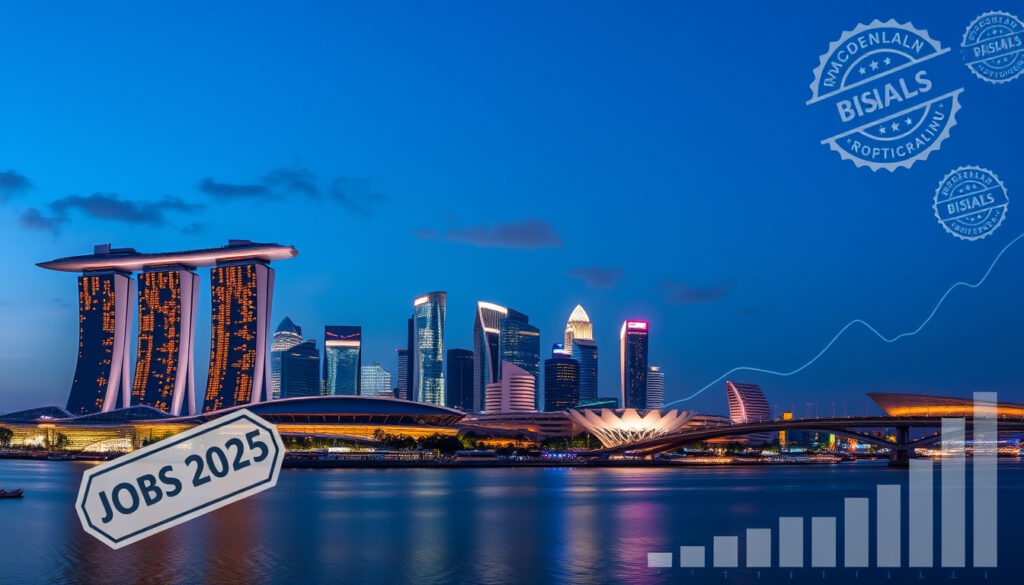
Singapore in 2025: Capital, President, Visa, Jobs & Salary
Planning a move or a trip to Singapore? You’re not alone—thousands of Tamil-speaking professionals and tourists head there every year, drawn by its reputation for efficiency, safety, and economic opportunity. This guide pulls together the essentials: from the capital and current president to visa fees, flight tips, and what jobs actually pay in 2025. Think of it as a practical starting point for anyone navigating Singapore from a Tamil perspective.
Capital: Singapore (city-state) ·
President (2025): Tharman Shanmugaratnam ·
Currency: Singapore Dollar (SGD) ·
Area: 734.3 km² ·
Population: ~5.9 million ·
Average Monthly Salary (2025): ~S$5,000
Quick snapshot
- Singapore is a city-state and its own capital (Singapore Government official portal)
- President Tharman Shanmugaratnam took office in September 2023 (Singapore Government)
- Employment Pass minimum salary is S$5,600 for 2025 (Ministry of Manpower labour regulator)
- Visa fee range: $30–$50 USD (Immigration & Checkpoints Authority official visa authority)
- Exact visa fee for Indian citizens may change in 2025 (Immigration & Checkpoints Authority official visa authority)
- Average salary varies by sector and experience; S$5,000 is a median estimate (Ministry of Manpower labour regulator)
- EP qualifying salary will rise to S$6,000 (general) and S$6,600 (financial services) for new applications from 1 January 2027 (Ministry of Manpower labour regulator)
- S Pass threshold will increase to S$3,600 (general) from 2027 (Ministry of Manpower press release)
- Job seekers should prepare for higher salary thresholds from 2027 (Ministry of Manpower labour regulator)
- Flight prices expected to remain competitive with advance booking (Singapore Airlines flag carrier)
Here are the key facts about Singapore at a glance.
| Label | Value |
|---|---|
| Official Name | Republic of Singapore |
| Government | Parliamentary republic |
| President (2025) | Tharman Shanmugaratnam |
| Capital | Singapore |
| Population | Approx. 5.9 million |
| Currency | Singapore Dollar (SGD) |
| Official Languages | English, Malay, Mandarin, Tamil |
| Area | 734.3 km² |
| Time Zone | UTC +8 |
What is the capital of Singapore?
Singapore is a city-state, meaning the entire country is a single city that serves as its own capital. There is no separate capital city like in India or Malaysia. The capital is simply called Singapore — the same name as the country. This makes it one of the few fully urbanised nations on Earth, alongside Monaco and Vatican City (Singapore Government official portal).
- Capital: Singapore city-state (Wikipedia encyclopedic reference)
- No other city serves as capital
What this means: For travellers and job seekers, this centralisation means nearly everything — government offices, business districts, airports, and main attractions — is within a compact area. You won’t need to travel between different cities for paperwork or sightseeing.
What is the name of the president of Singapore?
As of 2025, the President of Singapore is Tharman Shanmugaratnam. He was elected in September 2023 after a contested presidential election. Tharman, who is of Indian Tamil heritage, previously served as Deputy Prime Minister and Minister for Finance. The role of Singapore’s president is largely ceremonial, but includes oversight of the nation’s reserves and appointment of key office holders (Singapore Government official portal).
For Tamil-speaking readers, President Tharman’s background carries cultural resonance. While the president is not the head of government (that is the Prime Minister), his role as head of state makes him a unifying figure.
The implication: cultural familiarity does not change the fact that the President’s powers are largely symbolic, so job seekers should focus on the Prime Minister’s office for policy direction.
What currency is used in Singapore?
- Currency: Singapore Dollar (SGD) (Monetary Authority of Singapore central bank)
- Symbol: S$
- Subdivision: 100 cents
Banknotes are issued in denominations of S$2, S$5, S$10, S$50, S$100, S$500, and S$1,000. Coins come in 5, 10, 20, 50 cents, and S$1. ATMs are widely available. Most merchants accept credit cards, but for street food and small shops, cash is still king.
The trade-off: While the SGD is a stable, freely tradable currency, its value against the Indian Rupee can fluctuate. As of 2025, 1 SGD ≈ 62 INR. Budget-conscious travellers should monitor exchange rates before converting large sums.
How much does a Singapore visa cost?
Visa fees for Singapore vary depending on nationality and the type of visa. For Indian citizens, a short-term tourist visa typically costs between S$30 and S$50 (roughly USD $30–50). The fee is set by the Singapore Immigration & Checkpoints Authority (ICA) and is non-refundable even if the visa is denied (Immigration & Checkpoints Authority official visa authority).
How to apply for a Singapore visa?
- Apply online via ICA’s e-Service or through an authorised visa agent (Immigration & Checkpoints Authority official visa authority)
- Required documents: passport (6 months validity), completed application form, recent photo, travel itinerary, and proof of funds
- Processing time: 3 to 5 working days
Many Indian travellers use visa agents to handle the paperwork. Agents charge an additional service fee ranging from S$10 to S$30. While not mandatory, they can save time if you are unfamiliar with the online process.
Do I need an agent to apply for a Singapore visa?
No, you can apply directly through the ICA website without an agent. However, if you are applying from India, some ICA-authorised agents in India can submit applications on your behalf. It is not a legal requirement, but it may simplify the process for first-time applicants (Immigration & Checkpoints Authority official visa authority).
How to get a Singapore flight ticket?
Booking a flight to Singapore is straightforward, with multiple airlines serving Changi Airport (SIN), one of the world’s best-connected hubs. The cost depends on departure city, season, and how early you book.
Which airlines fly to Singapore?
- Singapore Airlines (flag carrier) – direct flights from major Indian cities (Singapore Airlines official website)
- Air Asia and IndiGo – budget options with connections via Kuala Lumpur or Bangkok
- Emirates – via Dubai (Emirates official website)
- British Airways, Cathay Pacific – from UK/Australia/Europe
Prices from Chennai, Mumbai, and Delhi start around ₹8,000–₹12,000 one-way on budget carriers during off-peak seasons. Booking 4–6 weeks in advance generally yields the best rates.
- Book through airline websites or travel portals like Skyscanner, Kayak, or MakeMyTrip (Skyscanner travel search engine)
- Changi Airport offers free Wi-Fi, gardens, and even a swimming pool – transit is a pleasure
Why this matters: For Tamil-speaking travellers, direct flights from Chennai (MAA) to Singapore take just over 4 hours — one of the shortest routes from India. That makes weekend trips and quick business visits very feasible.
What is the average salary in Singapore?
According to Singapore’s Ministry of Manpower, the median monthly salary for full-time employed residents in 2025 is around S$5,000. However, actual earnings vary widely by industry, experience, and work pass type (Ministry of Manpower labour regulator).
The table below shows the minimum salary thresholds for different work passes in 2025.
| Work Pass | Minimum Salary (general) | Minimum Salary (financial services) | Source |
|---|---|---|---|
| Employment Pass (EP) | S$5,600 | S$6,200 | Ministry of Manpower |
| S Pass | S$3,300 | S$3,800 | Ministry of Manpower press release |
| Work Permit | No fixed min (sector-specific) | – | Ministry of Manpower guidance |
Older, more experienced candidates need to meet higher salary floors. For example, an EP applicant aged 45 and above in the general sector must earn at least S$10,700 to qualify (Ministry of Manpower labour regulator).
The pattern: age-linked salary floors mean that experienced professionals must negotiate harder, not just on skills but on pay packets.
What job opportunities are available in Singapore in 2025?
- Technology – software engineering, data science, cybersecurity (LinkedIn professional network job listings)
- Finance – banking, fintech, insurance, asset management
- Healthcare – nurses, doctors, allied health (especially in private hospitals)
- Construction & Logistics – project managers, supply chain specialists
Job portals: JobStreet, LinkedIn, My Careers Future, and Glassdoor. Many employers sponsor Employment Passes for skilled roles.
While average salaries sound attractive, the cost of living in Singapore is high. A one-bedroom apartment in a central area can cost S$2,500–S$4,000 per month. Budgeting is essential.
mom.gov.sg, reglegbrief.com, evisa.amaderdiary.com, incorp.asia, pilotoasia.com, abroadmate.me, envoyglobal.com, eiglaw.com, edb.gov.sg
For those specifically interested in hospitality, hotel job opportunities in Singapore provide a detailed breakdown of salary thresholds and application steps for foreign workers.
Frequently asked questions
Is Singapore a city or a country?
Singapore is both a city and a country — a sovereign city-state. It has no separate capital city.
What is the weather like in Singapore?
Singapore has a tropical rainforest climate — hot, humid, and rainy year-round. Temperatures average 27–33°C. No distinct seasons, but the northeast monsoon (Nov–Jan) brings heavier rain.
Do I need a visa to travel to Singapore from India?
Yes, Indian passport holders need a visa for tourism or business. Fee: S$30–50. Apply through ICA or an authorised agent.
How much luggage is allowed on flights to Singapore?
It depends on the airline. Most full-service carriers allow 30–40 kg checked baggage for economy; budget airlines often charge extra for hold luggage. Check your booking for exact limits.
Can I work in Singapore without a job offer?
Generally no. You need a valid work pass (Employment Pass, S Pass, or Work Permit) sponsored by an employer. The exceptions are dependent passes for family members of work pass holders.
What is the cost of living in Singapore?
High. Rent, eating out, and childcare are expensive. A single person’s monthly expenses (excluding rent) can range from S$1,000 to S$2,500.
Is English widely spoken in Singapore?
Yes. English is one of four official languages and is the default language of business, government, and education. Tamil is also widely spoken among the Indian community.
For Tamil-speaking job seekers and travellers, the choice is clear: Singapore offers real economic opportunity and a familiar cultural foothold, but only if you plan for the salary thresholds, visa costs, and high living expenses. Either you come prepared with the right work pass and budget, or you risk a costly setback.
More related posts
 Xiaomi Service Centre Singapore: Repairs & Options
 What Can a Climate Voucher Be Used For? Buy List
 400 Euro to SGD: Convert EUR to Singapore Dollars
 A-Level Results 2025: Key Stats and Trends
 Singapore Driving License Renewal: Step-by-Step Guide
 Singapore to Hanoi Flights: Price, Time & Best Airlines
 Fusion Strike Card List – All 284 Cards by Rarity
 How to Test Smoke Detector Battery: Step-by-Step Guide