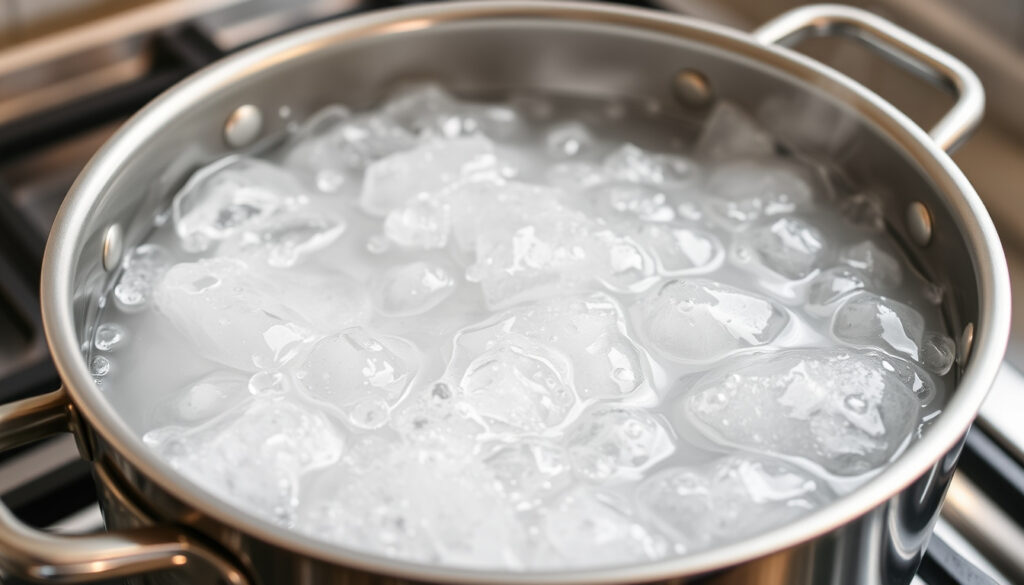
Rolling Boil: Definition, How to Spot It, and Tips
Anyone who’s boiled pasta or eggs has seen that frantic bubbling stage and wondered if it’s the same as a “rolling boil.” It’s not just aggressive boiling—it’s a precise cooking phase that professional cooks count on for even texture and fast, predictable results. Here’s what a rolling boil actually is, how to recognize it at a glance, and why it matters in your kitchen.
Boiling point of water at sea level: 212°F (100°C) · Bubble size at rolling boil: Large, vigorous, covering entire surface · Steam release rate: Continuous and generous · Common use: Pasta, eggs, blanching vegetables · Temperature for gentle simmer: 185–205°F (85–96°C)
Quick snapshot
- A rolling boil is a vigorous, sustained boil with large bubbles covering the entire surface (Martha Stewart (home-cooking authority))
- Water temperature reaches 212°F (100°C) at sea level (Allrecipes (cooking resource))
- Look for large bubbles that roll and burst continuously (Martha Stewart)
- Steam rises steadily; stirring doesn’t stop the boil (Martha Stewart)
- Cooking pasta, grains, and legumes (Martha Stewart)
- Hard-boiling eggs for even doneness (Allrecipes)
- Blanching vegetables to preserve color (Martha Stewart)
- Ensures even, predictable cooking times (Food Network (cooking education))
- Prevents food from sticking or clumping (e.g., pasta) (Martha Stewart) (Food Network (cooking education))
- Essential for recipes that require a specific boil stage (Allrecipes) (Food Network (cooking education))
Five key facts that define a rolling boil at a glance.
| Label | Value |
|---|---|
| Water temperature at rolling boil | 212°F (100°C) at sea level (Allrecipes) |
| Bubble size | Large (approx. 1-2 cm in diameter) and vigorous (Martha Stewart) |
| Steam output | Continuous, visible column of steam (Food Network) |
| Stir test | Boiling continues even when stirred (Martha Stewart) |
| Common applications | Pasta, hard-boiled eggs, blanching, sterilizing (Martha Stewart) |
What Is the Difference Between a Boil and a Rolling Boil?
Many recipes use “boil” loosely, but cooks recognize distinct stages. A rolling boil is the most aggressive phase—large bubbles that churn the entire surface and don’t pause when you stir. In contrast, a gentle boil and a simmer have smaller, quieter bubbles.
What is a gentle boil?
- Medium-sized bubbles that can be interrupted by stirring (Allrecipes)
- Water temperature still near 212°F but slightly less energetic (Sur La Table (cooking education))
What is a simmer?
- Small, occasional bubbles with steam wisps (Wikipedia – Culinary Technique)
- Temperature range: 185–205°F (85–96°C) (Sur La Table)
- Liquid is calm or only lightly moving (ThermoPro)
The implication: a rolling boil delivers maximum agitation and heat transfer, while simmering provides gentle cooking without breaking up delicate foods.
What Does a Rolling Boil Look Like?
Visual cues are the most reliable way to identify a rolling boil—no thermometer required.
Signs of a rolling boil in a pot
- Visible large bubbles bursting across the entire surface (Martha Stewart)
- Continuous churning and roiling motion (Food Network)
- Abundant steam rising from the pot (Martha Stewart)
- Stirring does not stop the boil (Martha Stewart)
Visual difference between rolling boil and simmer
- Rolling boil: large, vigorous bubbles that roll over each other; surface is turbulent (Allrecipes)
- Simmer: tiny, occasional bubbles; surface is calm (Sur La Table)
What this means: if you can see the bubbles from across the kitchen and they keep coming even when you stir, you’ve hit a rolling boil.
How Do You Know When You Have a Rolling Boil?
Beyond sight, sound and a quick stir test confirm the stage.
Kitchen hack to test for a rolling boil
- Give the water a strong stir with a spoon. If the bubbling continues without pause, it’s a rolling boil (Martha Stewart)
- If the bubbling stops or drastically slows, the water was at a gentle boil or simmer (Allrecipes)
Using sound and sight to identify a rolling boil
- The sound is a constant, loud churning, not a gentle sizzle (ThermoPro (kitchen thermometer brand))
- At sea level, water temperature should read 212°F (100°C) (Allrecipes)
- Bubbles are large and break vigorously at the surface (Martha Stewart)
The pattern: trust your ears—a rolling boil is loud and steady, not delicate.
What Is a Rolling Boil for Eggs?
Hard-boiled eggs benefit from the strong, even heat of a rolling boil. The high temperature and constant agitation help the egg whites set quickly while the yolk cooks through at a predictable rate.
Perfect hard boiled eggs using a rolling boil
- Bring water to a rolling boil before gently lowering eggs in (Martha Stewart)
- Boil time affects yolk texture: 10-12 minutes for hard-boiled, 6-7 minutes for medium (Allrecipes)
- High heat maintains the boil for precise timing (Food Network)
Why a rolling boil is needed for eggs
- Even cooking and consistent doneness (Martha Stewart)
- Prevents eggs from sticking to the bottom (CocuSocial (cooking class platform))
Why this matters: a rolling boil is the only stage that gives you that dependable, repeatable egg texture every time.
What Are the Signs of a Rolling Boil?
Combining all the cues into a quick checklist.
Key visual and auditory signs
- Large bubbles that roll over each other (Martha Stewart)
- Steam rising in a constant column (Food Network)
- Loud, continuous churning sound (ThermoPro)
- Visible from across the kitchen (Sur La Table)
Common mistakes to avoid
- Don’t confuse small bubbles at the bottom (simmer) with a rolling boil (Allrecipes)
- Don’t assume a few large bubbles near the edge mean a full boil—stir to test (Martha Stewart)
The catch: many home cooks mistake a rapid simmer for a rolling boil. If in doubt, use the stir test or a thermometer.
Comparing the key cooking stages side by side shows why the rolling boil stands apart.
| Stage | Temperature | Bubble size | Surface movement | Stir test |
|---|---|---|---|---|
| Slow simmer | ~185°F (85°C) | Tiny, few | Calm, barely moving | Bubbles stop if stirred |
| Regular simmer | ~195°F (91°C) | Small, steady streams | Gentle motion | Bubbles pause briefly |
| Rapid simmer | ~205°F (96°C) | Medium, frequent | Moderate agitation | Bubbles slow but don’t stop |
| Rolling boil | 212°F (100°C) | Large (1-2 cm), vigorous | Turbulent, churning | Boiling continues without pause |
How to Achieve and Identify a Rolling Boil: A Step-by-Step Guide
- Fill a pot with water and place it over high heat.
- Watch for small bubbles to form at the bottom (simmer stage).
- As heat continues, bubbles grow and rise to the surface.
- When large bubbles cover the entire surface and the water churns aggressively, you’ve reached a rolling boil.
- Perform the stir test: give the water a strong stir. If bubbling continues, it’s a rolling boil.
- Reduce heat if you need a gentler stage; maintain high heat to keep the rolling boil going.
- Use a thermometer for confirmation: 212°F (100°C) at sea level (Allrecipes).
Confirmed facts
- A rolling boil occurs at 212°F (100°C) at sea level (Allrecipes).
- Large, vigorous bubbles cover the entire surface (Martha Stewart).
- Stirring does not stop the boil (Martha Stewart).
What’s unclear
- Whether a “rolling boil” has a uniform definition across all cuisines (some cultures may use the term differently).
- Whether the exact temperature ranges for simmer (185-205°F) are universally accepted across all culinary traditions.
- Whether the visual cues for a rolling boil are identical for different pot sizes and burner types.
The step-by-step guide provides a reliable method to achieve a rolling boil consistently.
Expert perspectives on the rolling boil
“A rolling boil is the ideal technique for certain methods of cooking. The most common are boiling pasta, grains, and legumes and blanching vegetables.”
— Martha Stewart editorial team
“A rolling boil occurs when large bubbles burst on the surface of a liquid, usually water, causing a vigorous and sustained churning and a generous release of steam.”
— Food Network Essentials
For home cooks, mastering the rolling boil is the difference between al dente pasta that doesn’t clump and a mushy mess. The choice is clear: learn to spot that churning surface and your recipes will turn out consistently better—every single time.
reddit.com, andersonhousefoods.com, youtube.com, cocusocial.com, reddit.com, harrisscarfe.com.au, reddit.com
Achieving a rolling boil is essential for cooking perfect hard-boiled eggs with consistent results.
Frequently asked questions
How long does it take to reach a rolling boil?
It depends on your pot size, burner power, and starting water temperature. On a standard stove, a 4-quart pot typically reaches a rolling boil in 8–12 minutes.
Can you get a rolling boil at high altitude?
Yes, but at a lower temperature because atmospheric pressure is lower. Water boils at about 203°F (95°C) at 5,000 feet, so the rolling boil will be less vigorous. You may need to cook food longer.
Does a rolling boil make food cook faster?
Once water is at a rolling boil, adding more heat does not raise the temperature above 212°F (100°C) at sea level. It only produces more vigorous bubbling. Cooking time depends on the food, not the violence of the boil.
Should I cover the pot to reach a rolling boil?
Covering the pot traps steam and helps water reach a boil faster. Once you have a rolling boil, you can remove the lid unless the recipe says otherwise.
Is a rolling boil the same as a hard boil?
Yes, “hard boil” and “full boil” are common synonyms for a rolling boil. They all describe the same vigorous, sustained bubbling stage.
More related posts
 Chong Pang Nasi Lemak: Late-Night Stall Guide
 Singapore Currency to India: SGD to INR Rates Guide
 Chan Chun Sing Biography: Wife, Religion, Height, and Career
 Tims Restaurant & Cafe Menu: Prices, Dishes & Set Lunch
 Payment Crackdown: Trustly Withdraws as Nordic Regulators Tighten Net
 Game of the Year 2025 Winner, Nominees, and Controversies
 Hari Raya Haji Singapore – Dates, Significance and Traditions
 1 USD to THB: Exchange Rate, Cost & Salary Guide for Thailand