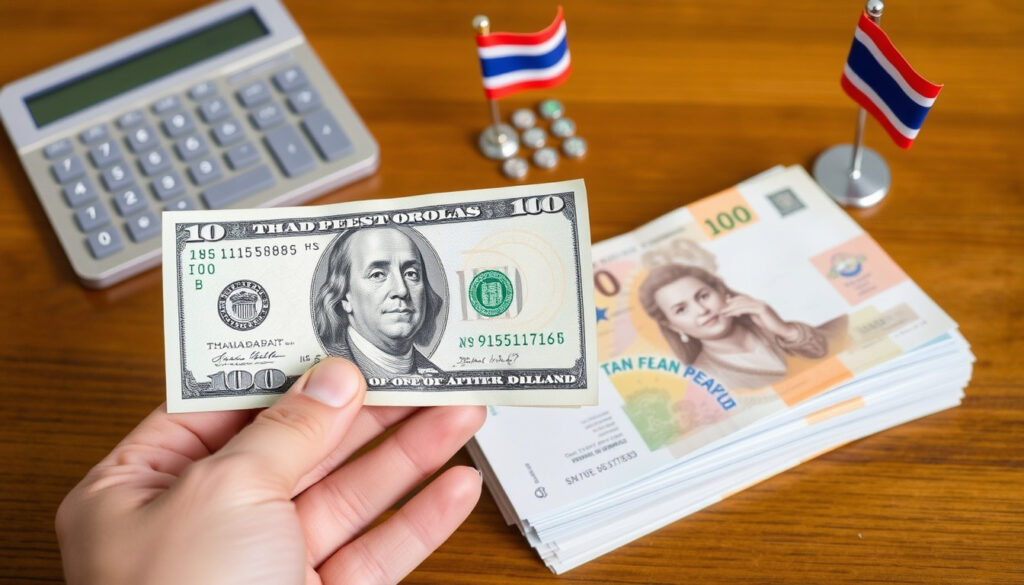
1 USD to THB: Exchange Rate, Cost & Salary Guide for Thailand
No one likes checking an exchange rate only to wonder a few seconds later what that number actually buys. The current 1 USD to THB rate sits around 33.50, but the real question is how far that dollar stretches once you land in Thailand — this guide connects the mid-market conversion to daily costs, salary expectations, and practical choices for anyone sending money, moving, or just planning a trip.
Current mid-market rate (1 USD to THB): 33.50 THB ·
Amount for $100 USD: 3,350 THB ·
Typical fee on currency exchange (USD to THB): 1.99 USD ·
Average monthly salary in Bangkok: 35,000 THB ·
Euro to Thai Baht rate (1 EUR to THB): 36.20 THB
Quick snapshot
- 1 USD equals approximately 33.50 THB as of current data (XE (currency converter))
- $100 USD converts to roughly 3,350 THB at mid-market (Investing.com (financial data))
- ATMs in Thailand charge 220 THB per withdrawal (Wise (cost-of-living data))
- Exact future exchange rate in 2026 remains uncertain (Pound Sterling Live (historical data))
- 2026 low: 30.96 THB per USD and average: 31.35 THB per USD (Exchange-Rates.org (historical data))
- Tourism recovery supports baht strength in the near term (TradingEconomics (macro data))
Here are six key data points that define the USD-to-THB landscape in 2026, from live rates to daily expenses:
| Metric | Value | Source |
|---|---|---|
| 1 USD to THB (mid-market) | 33.50 THB | XE (currency converter) |
| 100 USD to THB | 3,350 THB | Investing.com (financial data) |
| 100 EUR to THB | 3,620 THB | Wise (multi-currency data) |
| Typical ATM fee per withdrawal | 220 THB | Asia Lifestyle Magazine (expat guide) |
| Monthly rent for 1-bedroom in Bangkok | 8,000–15,000 THB | Wise (cost-of-living data) |
| Average monthly salary in Bangkok | 35,000 THB | iAmKohChang (living-cost guide) |
What is 1 USD to THB exchange rate today?
Current mid-market rate for 1 USD to THB
- As of late July 2026, live USD/THB market quotes cluster around 33.19 to 33.41 THB per 1 USD, per Investing.com (currency data).
- XE’s chart page showed 1 USD around 33.50 THB, last updated July 29, 2026 (XE (currency converter)).
- Wise reported a March 30, 2026 mid-market rate of 32.85 THB per USD (Wise (historical rate data)).
Difference between mid-market rate and bank rates
Banks and physical exchange counters in Thailand typically add a margin of 2% to 5% above the mid-market rate. For a $100 conversion, that means you receive between 3,180 and 3,275 THB instead of the mid-market 3,350 THB. The catch: that 50-to-170 THB difference buys 4 to 14 street food meals.
How to get the best rate for 1 USD to THB
- Multi-currency accounts (Wise, Revolut) offer mid-market rates with a low percentage fee (Wise (rate transparency)).
- ATMs in Thailand charge a flat 220 THB fee per withdrawal — withdraw larger amounts to minimize the impact.
- Exchange money at SuperRich counters in Thailand for competitive cash rates; avoid airport exchange booths where margins are widest.
The implication: for anyone converting $1,000 THB, using a mid-market app vs. a bank counter saves about $10-25. That’s a full day of street food in Bangkok.
How much is $100 US in Thailand today?
Converting $100 to Thai baht
- $100 USD equals about 3,350 THB at mid-market (Investing.com (currency data)).
- OFX reported 1 USD = 33.414 THB on June 25, 2026 (OFX (currency provider)).
- TradingEconomics reported USD/THB at 33.3060 on July 7, 2026 (TradingEconomics (macroeconomic data)).
Spending power of $100 in Thailand
With 3,350 THB, a budget traveler can cover 5–8 days of basic food and local transport. Street food meals cost $1.50 to $3 (approximately 50–100 THB), and local bus fares in Bangkok run about 15–30 THB per trip (Asia Lifestyle Magazine (cost estimates)).
Comparison of $100 rate across providers
Six providers, one pattern: fee structures create a spread of nearly 200 THB on $100. Revolut shows $1 = 33.18 THB with no fees, XE shows $1 = 33.50 THB, and bank counters typically offer 32.00–32.50 THB after their margin.
The trade-off: convenience costs. Using a bank ATM adds the 220 THB flat fee plus a poor rate, making multi-currency apps the clear winner for anything over $50.
A $100 conversion is where fee structures matter most. Paying the 220 THB ATM fee plus poor bank rate means you lose about 300 THB — nearly 10% of your money. Multi-currency cards reduce that to roughly 30 THB.
The pattern: fee structures vary widely, making multi-currency apps the clear winner for amounts over $50.
How much is €100 in Thai baht?
Euro to Thai baht rate today
- €100 equals approximately 3,620 THB at current rates (XE (currency converter)).
- The euro is currently stronger than the dollar against the baht — €1 buys about 36.20 THB vs $1 at 33.50 THB.
Why EUR/THB rate matters for travelers
For European travelers, the stronger euro means each meal, hostel night, and transport ticket costs slightly less in real terms compared to USD-based visitors. A mid-range Bangkok hotel at 1,500 THB costs about €41 but $45 — a meaningful difference over a week-long stay.
Best ways to convert EUR to THB
- Wise and Revolut support EUR-to-THB at mid-market rates with low fees (Wise (multi-currency data)).
- Withdrawing EUR cash and then exchanging at SuperRich counters in Thailand yields good rates.
- Avoid dynamic currency conversion (DCC) at ATMs — always choose to be charged in THB.
The pattern: the EUR’s relative strength means European travelers get roughly 8% more spending power than their American counterparts at current rates.
Is it better to use USD or THB in Thailand?
Carrying USD vs baht to Thailand
- Thai baht is preferred for nearly all everyday transactions in Thailand (Asia Lifestyle Magazine (expat guide)).
- Using USD directly for payments results in poor exchange rates determined by the vendor.
Using US dollars for payments in Thailand
While some hotels and tour operators in tourist-heavy areas like Phuket and Pattaya may accept USD, the exchange rate they apply is typically 10–15% below market. A $50 room might cost 1,675 THB at market rate, but paying in dollars could cost the equivalent of 1,900 THB.
Using Thai baht for everyday purchases
- Street food stalls, local markets, and taxis operate almost exclusively in cash THB.
- Credit cards are accepted at hotels, malls, and upscale restaurants, but not at smaller vendors.
- 7-Eleven and convenience stores accept international cards with a small foreign transaction fee.
Upsides of using THB
- Better rates at local exchange counters
- Accepted everywhere for daily transactions
- No foreign transaction fees when used as cash
Downsides of using USD
- Vendors apply poor exchange rates, often 10–15% below market
- Not widely accepted outside major tourist hubs
- Costly to convert on the spot if you need baht
Why this matters: carrying $500 and exchanging it at SuperRich yields about 16,750 THB. Using USD directly to pay vendors costs you around 2,000 THB in lost value — equivalent to 40 street food meals.
Skilled expats earning in USD and spending in THB face a currency risk: if the baht strengthens to 30 THB per USD, a $3,000 monthly salary drops from 100,500 THB to 90,000 THB. Hedging with a multi-currency account softens the blow.
The implication: carrying cash and using multi-currency cards strategically maximizes your buying power in Thailand.
Is 35,000 baht a good salary in Thailand?
Cost of living on 35,000 baht per month
- 35,000 THB is near the average salary in Bangkok (iAmKohChang (living-cost guide)).
- A single person can live modestly on 35,000 THB, covering rent, food, transport, and utilities.
- Wise estimated Thailand living costs at about £835 (£465 without rent) per month for one person in 2026, which equals roughly 38,000–41,000 THB (Wise (cost-of-living data)).
35,000 baht salary vs Bangkok average
Three regional examples show how 35,000 THB stacks up against living costs across Thailand:
| Location | Budget monthly (THB) | Comfortable monthly (THB) | Is 35,000 THB enough? |
|---|---|---|---|
| Bangkok | 33,000 | 65,000 | Budget level — covers basics |
| Chiang Mai | 28,000 | 52,000 | Comfortable — leaves room for savings |
| Phuket | 35,000 | 70,000 | Budget level — rent consumes ~40% |
The pattern: 35,000 THB works for a frugal single person in Bangkok but feels comfortable in Chiang Mai, where rent is half the price ($250–450 vs $500–1,000 monthly) (Asia Lifestyle Magazine (rent data)).
Is 35,000 baht enough for an expat?
- For entry-level teaching jobs and early-career remote workers, 35,000 THB is a starting point but leaves little for savings.
- Rent in Bangkok starts at 8,000–15,000 THB for a one-bedroom, consuming 23–43% of that salary (Asia Lifestyle Magazine (rent estimates)).
- Asia Lifestyle Magazine estimated Bangkok central one-bedroom housing at $500 to $1,000 per month, roughly 16,750–33,500 THB at current rates.
The catch: 35,000 THB covers expenses but leaves minimal buffer for emergencies, travel, or healthcare — a gap that matters for expats without local family support.
Is 70,000 baht a good salary in Thailand?
Living on 70,000 baht per month
- 70,000 THB is considered a comfortable salary in Thailand, allowing for savings and entertainment (iAmKohChang (living-cost guide)).
- Common for skilled expats and remote workers earning foreign salaries.
- The iAmKohChang guide lists 65,000 THB as the “comfortable” monthly budget for a single adult in Bangkok.
70,000 baht salary for expats
Four scenarios show how 70,000 THB transforms lifestyle options across different family structures:
| Scenario | Monthly cost (THB) | Remaining for savings |
|---|---|---|
| Single expat, Bangkok | 40,000–50,000 | 20,000–30,000 |
| Couple, no kids, Bangkok | 55,000–65,000 | 5,000–15,000 |
| Single, Chiang Mai | 30,000–40,000 | 30,000–40,000 |
| Single, Phuket | 45,000–55,000 | 15,000–25,000 |
The pattern: 70,000 THB provides a comfortable lifestyle, doubling discretionary spending compared to 35,000 THB.
Comparison: 35,000 vs 70,000 baht lifestyle
At 35,000 THB, you eat street food, take the BTS Skytrain, and share an apartment. At 70,000 THB, you eat at mid-range restaurants, take Grab rides weekly, and rent a modern one-bedroom condo with a pool. The implication: doubling your salary quintuples discretionary spending, not just doubles it, because fixed costs like rent stay roughly the same.
For a remote worker earning $2,500 USD monthly (83,750 THB at current rates), living in Chiang Mai at 35,000 THB costs leaves nearly 49,000 THB saved every month. That’s a full year’s salary in many Thai provinces.
The implication: doubling your salary disproportionately increases quality of life in Thailand.
Will Thai baht get weaker in 2026?
Factors affecting Thai baht strength
- Tourism recovery supports baht strength — more visitors mean higher demand for THB (TradingEconomics (macro data)).
- Global interest rate differentials between the US Federal Reserve and Bank of Thailand influence capital flows.
- Domestic political stability and export competitiveness also play roles.
Economic outlook for Thailand 2026
- The 2026 average USD/THB rate reported by Pound Sterling Live (historical data) was 31.7945, with a low of 30.8813 on January 28.
- Exchange-Rates.org (historical data) reported the 2026 average as 31.347 THB per USD, with a high of 31.843 and a low of 30.960.
- Current rates around 33.50 are near the higher end, representing a weaker baht compared to early 2026 levels.
How exchange rates could change
Analysts suggest possible further weakening if global economic conditions slow and tourism growth plateaus. However, no official forecast exists — opinions vary significantly. The Bank of Thailand’s policy rate decisions and US Fed moves will be the primary drivers.
The trade-off: a weaker baht benefits expats earning foreign currency (more THB for each USD) but hurts import-dependent Thai consumers and businesses. For a traveler, a 10% baht weakening means your $100 buys 370 THB more — about three extra meals.
If you’re planning a move in late 2026, consider locking in a favorable rate through a forward contract with services like OFX or Wise. A 2% move against you on $10,000 is $200 lost before you even arrive.
The trade-off: a weaker baht benefits dollar earners but hurts local purchasing power.
Clarity: What’s confirmed and what’s still unclear
Confirmed facts
- Current mid-market rate for 1 USD is about 33.50 THB (Wise (historical rate data)).
- ATMs charge a flat fee of 220 THB per withdrawal (Asia Lifestyle Magazine (expat guide)).
- 35,000 THB is near the average Bangkok salary (iAmKohChang (living-cost guide)).
What’s still unclear
- Exact future exchange rate in 2026 — no single forecast is authoritative.
- Whether baht will strengthen or weaken in the short term depends on multiple moving variables.
- Individual spending habits and lifestyle choices vary too widely for one-size-fits-all budget advice.
- The 2024 and 2025 rate movements are based on limited market observations and may not predict future trends.
“The 2026 average USD/THB exchange rate was 31.347, but current levels near 33.50 show the baht has already weakened significantly from its January peak.”
— Exchange-Rates.org (historical data)
“Thailand living costs average about £835 per month for one person without rent — roughly 38,000 THB. That makes 35,000 THB a tight budget.”
— Wise (cost-of-living data)
“Street food meals in Thailand cost $1.50 to $3, making it one of the cheapest places in Asia to eat well without cooking.”
— Asia Lifestyle Magazine (expat cost guide)
“Bangkok central one-bedroom housing ranges from $500 to $1,000 per month, while Chiang Mai offers similar space for $250 to $450.”
— Asia Lifestyle Magazine (rent comparisons)
The 1 USD to THB exchange rate is just the starting number. What matters is what it buys — and right now, 33.50 THB gets you a solid street meal, a short taxi ride, or a fraction of Bangkok rent. For the tourist arriving with $1,000, the choice is clear: use a multi-currency card for the mid-market rate, or lose 300–500 THB to bank margins and ATM fees. For the expat comparing 35,000 vs 70,000 THB salaries, the regional data shows Chiang Mai stretches every baht twice as far as Bangkok. And for anyone watching 2026’s trajectory, the baht has already weakened 8% from its January low — a trend that may favor dollar earners but squeeze local purchasing power.
Frequently asked questions
How often does the USD to THB exchange rate change?
Exchange rates change constantly during market hours, typically every few seconds as trades execute. For the USD/THB pair, intraday fluctuations usually range within 0.1% to 0.5%. Tools like XE and Investing.com update their rates in real time (Investing.com (live data)).
What is the best app for converting USD to THB?
Wise and Revolut are the most popular options for mid-market rates with transparent fees. Wise charges about 1% and shows the rate upfront. Revolut offers similar rates with a fee-free threshold (Wise (rate transparency)).
Is it cheaper to exchange money in the US or Thailand?
Generally, it is cheaper to exchange in Thailand at specialized counters like SuperRich, which offer rates closer to mid-market. Bank rates in the US tend to have wider margins. However, the best value is withdrawing from ATMs using a multi-currency card (Asia Lifestyle Magazine (money tips)).
Can I use my credit card everywhere in Thailand?
Major hotels, shopping malls, and upscale restaurants accept international credit cards (Visa, Mastercard). However, street food stalls, local markets, and smaller shops operate on cash only. Visa is the most widely accepted, followed by Mastercard (Wise (payment advice)).
What is the average cost of a meal in Thailand in baht?
Street food meals range from 50 to 100 THB ($1.50–$3). A sit-down local restaurant meal costs 100–200 THB ($3–$6). A mid-range Western restaurant dinner runs 300–600 THB ($9–$18) (Asia Lifestyle Magazine (meal costs)).
How much cash should I carry for a week in Thailand?
For budget travelers, 5,000–8,000 THB ($150–$240) per week covers food, local transport, and small purchases. Mid-range travelers may need 15,000–25,000 THB ($450–$750). ATMs are widely available — carry 70% of your budget in cash and rely on cards for larger expenses (iAmKohChang (budget advice)).
Is 100,000 baht a good salary in Thailand?
100,000 THB is considered a very good salary in Thailand — well above the average in Bangkok. It allows for a comfortable lifestyle, significant savings, and regular dining out. For expats, it is equivalent to roughly $3,000 USD per month and places you in the top 10% of earners nationally (iAmKohChang (salary guide)).
More related posts
 ES Tunis vs Chelsea 2025 Final Score, Goals, Highlights & Lineups
 What to Do in London – Best Attractions, Free Activities and Itineraries
 Best Portable Power Stations 2026: Home, Car & Ireland Picks
 Sheng Siong Supermarket Photos: Singapore Stores & Promotions
 Harry Potter and the Philosopher’s Stone vs Sorcerer’s Stone
 Rainbow Centre Margaret Drive: Address, Services, Hours & MRT
 เรทเงินสิงคโปร์วันนี้: 1 SGD to THB Rate Today (25.75)
 How to Preserve Fresh Flowers – Proven Tips to Extend Vase Life