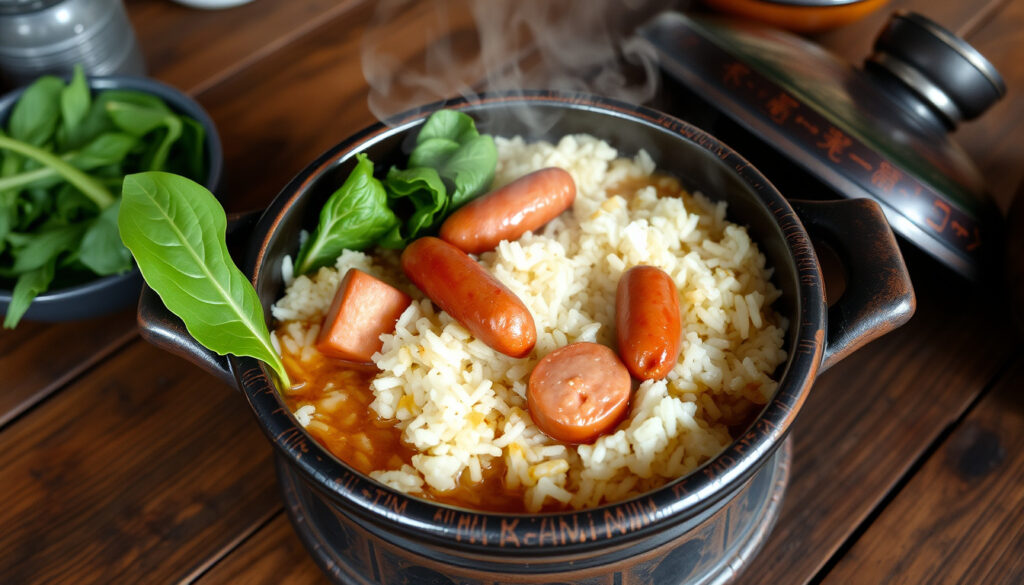
Sembawang Traditional Claypot Rice: Unique & Where to Find
Few things in Singapore’s hawker scene still reward patience like a pot of claypot rice cooked over charcoal. At Sembawang Traditional Claypot Rice, every order takes 10–15 minutes — not because of inefficiency, but because the stall refuses to swap its charcoal fire for a gas flame.
Established: Over 10 years in Sembawang, Singapore ·
Cooking method: Charcoal-fired claypot, made to order (10–15 min) ·
Signature ingredients: Chicken, Chinese sausage, salted fish, bakchoy ·
Average price (2025): SGD 6–10 per pot ·
Delivery: Free islandwide via Getz
Quick snapshot
- Charcoal fire is used to cook each pot fresh upon order (Live2Makan food blog)
- Menu includes chicken, Chinese sausage, salted fish, bakchoy (Getz official order page)
- Free islandwide delivery via Getz platform (same source) (Live2Makan food blog)
- Exact establishment year of the stall (not publicly recorded)
- Specific rice variety used (jasmine assumed but not confirmed by the stall)
- Exact water ratio the stall uses (not published)
- Whether the rice is pre-soaked before cooking (no source confirms)
- 2022 — featured on Live2Makan blog
- 2023+ — expanded to online ordering and free islandwide delivery via Getz (per official Getz page) (Live2Makan blog)
- Islandwide delivery now available via Getz — reachable beyond Sembawang
- Growing attention from food bloggers may push more diners to try the charcoal-fired method
Six key facts about Sembawang Traditional Claypot Rice, drawn from the official menu and verified reviews:
| Attribute | Detail |
|---|---|
| Cuisine | Singaporean / Cantonese-style claypot rice |
| Cooking fuel | Charcoal fire (SethLui food guide) |
| Average cooking time | 10–15 minutes per pot (TripAdvisor user reviews) |
| Key ingredients | Chicken, Chinese sausage, salted fish, bakchoy, dark soy sauce |
| Rice type | Long-grain (likely jasmine) |
| Delivery | Free islandwide in Singapore via Getz (same source) |
What makes Sembawang claypot rice unique?
Charcoal-fired cooking process
- The stall uses a traditional charcoal fire rather than a gas stove or induction cooker. According to the Live2Makan food blog, the rice absorbs a distinctive smoky aroma that electric cooking simply cannot replicate.
- The claypot itself is placed directly over the burning charcoal, which creates intense bottom heat and produces the coveted caramelised crust (Wikipedia – Claypot rice).
Fresh made-to-order preparation
- “Every pot of claypot rice is cooked fresh upon order,” notes the SethLui food guide. The 10–15 minute wait is part of the experience — no pre-cooked batches are used.
Signature ingredient blend (salted fish, Chinese sausage)
- The combination of chicken, Chinese sausage (lap cheong), salted fish, and bakchoy creates a layered umami profile. A TripAdvisor reviewer described the balance as “perfect”, with diners adding their own dark soy sauce and oil at the table.
Bottom line: Sembawang Traditional Claypot Rice preserves a dying craft — charcoal-fired claypot rice — in a hawker landscape that has largely switched to gas. For purists, that smoky crust is worth the wait and the trip.
What kind of rice is used in claypot rice?
Long-grain rice vs jasmine for claypot
- Most Singapore claypot rice stalls, including Sembawang, use long-grain jasmine rice for its fluffy, separate grains after cooking. Serious Eats (cooking resource) recommends jasmine for its fragrance and ability to absorb smoky flavours.
- Short-grain rice creates a stickier texture, which is less traditional for Cantonese-style claypot rice.
Why rice type affects texture and crust
- The starch content of jasmine rice helps form the coveted crispy layer at the bottom (the “guo ba”). According to Serious Eats, the right rice-to-water ratio (1:1.2 to 1:1.5) is critical; too much water and the crust never forms.
Using the wrong rice type turns a signature dish into a soupy mess. For Sembawang, the choice of jasmine is deliberate — it’s the only rice that can simultaneously stay fluffy and produce that burnt-bottom crust.
What’s the difference between claypot and regular rice?
Texture: crusty bottom vs fluffy all through
- Claypot rice develops a deep-brown caramelised crust at the bottom from direct heat. Regular rice cooker rice stays uniformly soft.
- The crust adds a nutty, slightly bitter counterpoint to the savoury toppings (Saveur magazine).
Flavour: smoky vs neutral
- Charcoal-fired claypot rice picks up a distinct smokiness that a standard rice cooker cannot produce. YouTube documentary on HK claypot rice calls this “the soul of the dish”.
Cooking time and method
- Rice cookers steam at a consistent 100°C. Claypots over charcoal reach higher direct-heat temperatures, cooking the rice in about 10–15 minutes while simultaneously charring the bottom.
Bottom line: The trade-off is patience for texture. A rice cooker is convenient; claypot rice delivers contrast — fluffy top, crunchy bottom, smoky aroma — that no appliance can mimic.
Why is claypot rice so good?
Umami from ingredients
- The classic Sembawang combination — chicken, Chinese sausage, salted fish, dark soy sauce — creates a triple umami hit. Wikipedia notes that lap cheong and salted fish are traditional Cantonese umami sources.
Smoky char from charcoal
- Charcoal combustion releases compounds that infuse the rice with a campfire-like aroma. This is the single biggest difference from electric cooking, and it’s what reviewers at Live2Makan repeatedly highlight.
Textural contrast
- Soft fluffy rice on top, a crisp golden crust at the bottom, tender chicken, chewy sausage, and crunchy bakchoy — all in one bowl. The variety keeps every bite interesting.
Claypot rice succeeds not because of one ingredient but because of the interplay: charcoal heat + fatty sausage + salty fish + crisp greens. Remove any one, and the magic fades.
What is the rice to water ratio for claypot rice?
Standard ratio for claypot (1:1.2 to 1:1.5)
- According to Serious Eats, the ideal ratio is 1 cup rice to 1.2–1.5 cups water. This ensures the grains are fully cooked without being mushy, and enough moisture evaporates to form the crust.
- Sembawang does not publish its exact ratio, but this range is standard for Cantonese claypot rice.
Adjustment for different rice types
- Jasmine rice (low amylose) needs slightly less water than aged long-grain. The same guide advises 1:1.2 for jasmine, 1:1.5 for standard long-grain.
Pre-soaking technique
- Pre-soaking rice for 30 minutes reduces cooking time and improves grain texture. It’s a common but not universal practice; Sembawang’s method is unconfirmed.
The implication: Sembawang’s method remains proprietary, but these ratios offer a reliable starting point for home cooks.
Where to find Sembawang Traditional Claypot Rice and what does it cost?
Location and operating hours
- The stall is located at 4 Jalan Tampang, Singapore 758948, inside Sembawang Garden Arcade (Live2Makan). The shophouse has white-washed walls and white tiles — no frills, just food. Contact: +65 6757 7144.
Menu items and price range
- The signature Traditional Claypot Rice is priced at SGD 13.80 on the official delivery site (Getz). Other platforms show variations: SGD 9.00 for a small pot (PriceListo), SGD 15.80 on Foodpanda Sembawang, and SGD 12.80 on Foodpanda Islandwide.
- Other menu items include Golden Crispy Salted Egg Prawns (SGD 30.80), Claypot Seafood Da Lu Mian (SGD 16.80), Lap Cheong Fried Rice (SGD 9.80), and set meals for groups (Set A 10 pax SGD 208.80, Set B 3 pax SGD 68.80) per the Getz page.
Delivery options (free islandwide via Getz)
- Islandwide delivery is free through the Getz platform. Minimum order may apply — check the site for details.
The price variation across platforms is striking. One pattern: ordering directly through Getz or picking up in person is cheaper than via Foodpanda.
| Item | Price (SGD) | Platform |
|---|---|---|
| Traditional Claypot Rice (Small) | 9.00 | PriceListo |
| Traditional Claypot Rice (Regular) | 13.80 | Getz |
| Traditional Claypot Rice (Medium) | 15.90 | PriceListo |
| Traditional Claypot Rice (Sembawang) | 15.80 | Foodpanda |
| Traditional Claypot Rice (Islandwide) | 12.80 | Foodpanda |
Why the spread? Delivery aggregators charge the stall a commission, so diners who order direct via Getz pay less. The trade-off is clear: convenience costs SGD 2–3 extra.
Another set of detailed specs for the traditional claypot rice dish:
| Spec | Detail |
|---|---|
| Rice type | Long-grain jasmine (assumed) |
| Water ratio (guideline) | 1:1.2 to 1:1.5 (Serious Eats) |
| Cooking vessel | Unglazed claypot |
| Heat source | Charcoal fire |
| Cooking time | 10–15 minutes |
| Base seasoning | Dark soy sauce, sesame oil, ginger |
| Key toppings | Chicken, Chinese sausage, salted fish, bakchoy |
| Optional add-ins | Extra dark soy sauce, chili, oil (at table) |
| Delivery minimum | Free islandwide via Getz (no minimum specified) |
Confirmed facts vs what remains uncertain
Confirmed facts
- Stall uses charcoal fire to cook claypot rice fresh upon order (multiple review sources)
- Menu includes chicken, Chinese sausage, salted fish, bakchoy
- Free islandwide delivery available via Getz platform
- Located at 4 Jalan Tampang, Singapore 758948 (Live2Makan)
What remains unclear
- Exact establishment year (not publicly documented)
- Specific rice variety used (jasmine assumed but not confirmed by stall)
- Exact water ratio used by the stall (not published)
- Whether rice is pre-soaked before cooking
- Exact recipe for soy sauce mix (proprietary)
“A perfect balance of chicken, Chinese sausage, bakchoy and salted fish.”
— Reviewer, Live2Makan (2022)
“Sembawang Traditional Claypot Rice is well-known for its authenticity—every pot of claypot rice is cooked fresh upon order.”
— Reviewer, SethLui
“It takes about 10 minutes for the rice to be cooked, it is made to order. Add in your own amount of dark soy sauce and oil for extra flavors.”
— TripAdvisor user
The three voices agree on one thing: freshness and tradition are the draw. The catch is that the stall’s methods are kept close — no official recipe, no confirmed timeline. For now, diners trust the result, not the process.
For anyone craving authentic charcoal-fired claypot rice in Singapore, the choice is clear: head to Sembawang, order the traditional pot, and taste a tradition that’s becoming harder to find. Either make the trip to Jalan Tampang or use Getz for free islandwide delivery — but don’t expect the same crust if you reheat it at home.
Frequently asked questions
Does Sembawang Traditional Claypot Rice offer vegetarian options?
The menu focuses on meat and seafood. No dedicated vegetarian pots are listed, but you can request without meat — though the rice is cooked with chicken fat and soy sauce.
Can I order Sembawang claypot rice for delivery outside Singapore?
Delivery is limited to Singapore islandwide via Getz. International shipping is not offered.
Is there a minimum order amount for free delivery?
The Getz page does not state a minimum. However, delivery aggregators like Foodpanda may have a minimum order of SGD 12–15.
How should I reheat leftover claypot rice?
To preserve the crust, reheat in a pan over low heat with a splash of water. Avoid microwaving — it softens the crust into mush.
Does the stall accept credit card payments?
At the shop, cash is preferred. Online orders through Getz and Foodpanda accept credit cards.
What is the best time to visit to avoid long waits?
Weekday afternoons (2–4 pm) are quietest. Dinner rush on weekends can mean 20–30 minute waits.
More related posts
 Snow White Box Office: $206M Gross, $170M Loss
 Time in Germany Now: CEST UTC+2 Berlin Frankfurt
 Things to Do at Changi Airport: Free Attractions & Tips
 Dubai Currency in India – Current AED to INR Rates Guide
 PAssion Wave @ Marina Bay: Kayak, Dragon Boat & Visitor Guide
 1 Million Baht to SGD: Convert THB to Singapore Dollars
 33 Ubi Avenue 3: Vertex Directions, Rent & MRT Info
 Work-Life Balance – Definition Benefits and Strategies