Spiderman Into The Spider Verse – Review and Analysis
Breaking the Mold: An Introduction
December 2018 marked a pivotal moment for animated storytelling when Spider-Man: Into the Spider-Verse premiered in theaters. Sony Pictures Animation collaborated with Marvel Entertainment to produce a feature that would eventually gross over $384 million worldwide and secure the Academy Award for Best Animated Feature. Unlike previous superhero adaptations, this installment positioned Miles Morales, a Black Hispanic teenager from Brooklyn, as the central protagonist. Sony Pictures’ official release emphasized the film’s commitment to visual innovation alongside narrative authenticity.
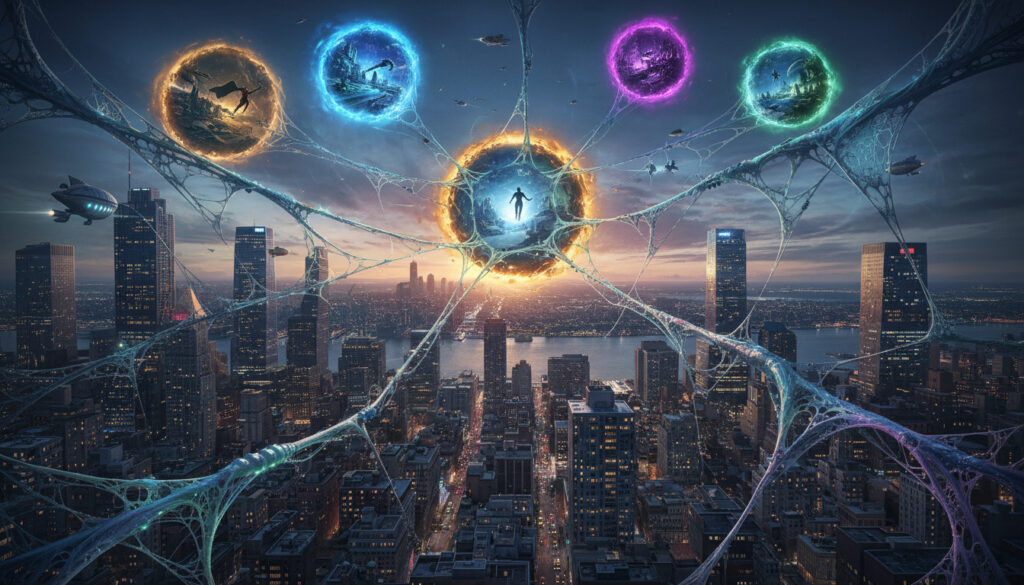
The Spider-Verse Grid
The narrative structure hinges on the collision of multiple dimensions, each delivering a distinct Spider-Person with unique characteristics:
Miles Morales
Voiced by Shameik Moore, this 14-year-old Brooklynite struggles with academic expectations and newfound arachnid abilities following a radioactive spider bite.
Peter B. Parker
Jake Johnson portrays a jaded, middle-aged Spider-Man from an alternate dimension who reluctantly mentors Miles while grappling with his own personal failures.
Spider-Gwen
Hailee Steinfeld lends voice to Gwen Stacy, a drummer from a universe where she received the spider bite rather than Peter Parker.
Ham, Peni, and Noir
The ensemble expands with John Mulaney’s Spider-Ham, a cartoon pig; Kimiko Glenn’s Peni Parker, a young girl piloting a radioactive spider mecha; and Nicolas Cage’s Spider-Man Noir, a 1930s-style black-and-white detective.
Visual Innovation Insights
The production team rejected conventional CGI aesthetics in favor of a hybrid approach that mimicked comic book printing techniques. Animation Magazine’s coverage detailed the use of halftone patterns, chromatic aberration, and Ben-Day dots integrated at the shader level. Animators employed frame rate variation, rendering background elements on twos while keeping characters on ones, creating a deliberate staccato effect that evoked hand-drawn animation. The technique required developing proprietary software to manage the complexity of mixing 2D and 3D assets without sacrificing the illustrated quality.
Cast and Creative Team
| Role | Voice Actor | Universe Designation |
|---|---|---|
| Miles Morales | Shameik Moore | Earth-1610 |
| Peter B. Parker | Jake Johnson | Earth-616 |
| Spider-Gwen | Hailee Steinfeld | Earth-65 |
| Doctor Octopus | Kathryn Hahn | Earth-1610 |
| Wilson Fisk | Liev Schreiber | Earth-1610 |
| Aunt May | Lily Tomlin | Earth-1610 |
Production Details
Phil Lord and Christopher Miller served as writers and producers, bringing their signature meta-humor and narrative density to the superhero genre. Their approach diverged from traditional studio mandates by prioritizing artistic vision over franchise uniformity. The directors, Bob Persichetti, Peter Ramsey, and Rodney Rothman, managed a crew of 177 animators across three countries. Collider’s interviews with the directing team revealed the challenge of maintaining visual coherence while allowing each universe its distinct aesthetic language, from the anime influences of Peni’s dimension to the stark shadows of Noir’s timeline.
Development Timeline
- : Sony announces development of an animated Spider-Man feature with Phil Lord and Christopher Miller attached.
- : Sony confirms the film would focus on Miles Morales rather than Peter Parker.
- : Shameik Moore cast as the voice of Miles Morales.
- : Experimental animation tests begin, establishing the film’s unique visual style.
- : First footage debuts at CinemaCon, generating significant industry buzz.
- : Theatrical release in the United States. IMDb records indicate the premiere coincided with critical consensus building immediately.
Clarifying the Canon
Despite Marvel Studios’ dominance in the superhero landscape, Into the Spider-Verse exists entirely outside the Marvel Cinematic Universe continuity. Sony Pictures retains exclusive film rights to Spider-Man and associated characters, allowing for this standalone interpretation. The film’s multiverse concept, while similar to later MCU developments, operates under distinct rules and visual logic. Additionally, the character of Miles Morales debuted in Marvel Comics’ Ultimate Universe in 2011, created by Brian Michael Bendis and Sara Pichelli, establishing his legitimacy as a Spider-Person separate from the Peter Parker legacy.
Cultural Analysis
The film’s release represented a shift in representation within mainstream animation. By centering a Black Hispanic protagonist and incorporating hip-hop elements into its score and visual language, the production attracted demographics traditionally underserved by superhero media. Variety’s review noted the film’s ability to balance fan service with genuine emotional stakes, particularly in its handling of Miles’s relationship with his father and uncle. The success demonstrated that experimental animation styles could compete with photorealistic CGI, influencing subsequent productions across the industry.
Creator Perspectives
“We wanted to make a movie that felt like a comic book, not just looked like one. That meant embracing imperfections, honor lines, and the texture of paper.”
— Phil Lord, Writer/Producer
“Miles is so specific. He’s from Brooklyn, he’s brown, he’s got a different rhythm to him than Peter Parker.”
— Shameik Moore, Voice of Miles Morales
“Every frame is a piece of art. We weren’t trying to make something realistic; we were trying to make something expressive.”
— Bob Persichetti, Director
Legacy Summary
With a 97% approval rating on Rotten Tomatoes and widespread recognition for its technical achievements, the film redefined expectations for superhero animation. The sequel, Spider-Man: Across the Spider-Verse, expanded the narrative scope while maintaining the original’s commitment to visual diversity. The production established Sony Pictures Animation as a viable alternative to Disney-Pixar dominance in the feature animation space, proving that risk-taking in both storytelling and aesthetics yields commercial and critical dividends.
Frequently Asked Questions
Is Spider-Man: Into the Spider-Verse connected to the Marvel Cinematic Universe?
No. The film exists within Sony’s separate Spider-Man film rights, distinct from Disney’s Marvel Cinematic Universe continuity. While multiverse concepts appear in both franchises, they operate independently with different narrative rules.
What makes the animation style unique compared to other CGI films?
The production utilized frame rate variation, comic book halftone patterns, and deliberate line work to simulate the texture of printed paper. Animators lowered frame rates for background elements while maintaining higher rates for characters, creating a kinetic, hand-crafted aesthetic unseen in conventional computer animation.
Who created Miles Morales originally?
Writer Brian Michael Bendis and artist Sara Pichelli created Miles Morales for Marvel Comics’ Ultimate Universe in 2011. Following the death of Peter Parker in that continuity, Miles assumed the Spider-Man mantle before eventually migrating to the main Marvel Universe.
Did the film win any Academy Awards?
Yes. At the 91st Academy Awards, the film won Best Animated Feature, defeating nominees including Incredibles 2, Isle of Dogs, Mirai, and Ralph Breaks the Internet.
More related posts
 Yi He Tang TCM: Services, Price, Appointment & Reviews (2024)
 Bangladesh National Cricket Team: Stats, Players, Schedule & News
 Gardens by the Bay MRT: Walking Routes & Station Guide
 Translate English to Myanmar Unicode: Top Tools
 Best Singapore Gifts for Overseas Friends: Top Souvenirs
 UOB Fixed Deposit Promo June 2025 – Rates, Eligibility and Comparisons
 FC Barcelona vs Inter Milan Stats: Head-to-Head & 2025 Review
 Hari Raya Haji Singapore – Dates, Significance and Traditions